Pages

Showing posts with label Foreign Language. Show all posts

Wednesday, October 22, 2014

REVIEW: Middlebury Interactive Languages

For this school year, I'm doing something we haven't done before: exploring options for online classes. My oldest is in high school now, and there are some areas in which I could use some extra support. I haven't been consistent in teaching foreign language. I couldn't decide what to teach; I took a fair bit of French in college, but I wondered if Spanish would be more useful; I wanted to teach Latin but wasn't sure how I wanted go about doing that; etc. We were recently given the opportunity to review a six month subscription to Middlebury Interactive Languages, and I was excited to try it out. I had my oldest daughter, who is in 9th grade, enroll in their high school French Courses

They offer courses in Spanish, French, German and Chinese, for students in grades K-12. Note that only Spanish is offered for the K-2 grades at this time.


We were a little confused when we first logged in, but once we figured out what was going on, the program was very easy to use. Upon logging in, we saw this screen:


Honestly, I wondered what on earth we were supposed to do, but we did finally notice the little arrow at the bottom right of the screen in the "Up Next" section. 

When you put in your start date for the course, a calendar is automatically set up for you with the lessons all scheduled. Middle school and high school lessons are scheduled 5 days per week, for a total of 90 lessons per semester. 


There is also a Table of Contents, where you can see all the lessons listed. When you click on a lesson folder, it opens up so you can see each part of the lesson. In the semester overview, you are able to see what will be covered in your lessons.


The course begins with an explanation of Student Resources, which walks you through what you need to know about using the course. My daughter and I appreciated the information they provided on typing in accents on the Mac, particularly. That was very helpful. Another useful option is the ability to print each unit's vocabulary list. When you click "Print," you get a lovely PDF file with all the words and the translations listed for you. Voilà! (My recommendation is to print the lists and put them in a notebook, minimally; ideally the student would copy them into a notebook. Physically writing things out makes a BIG difference in retention, in my experience.)


Each unit has 5 lessons, and each lesson incorporates varied activities that help the student connect with the language they are learning. Each day's lesson is a little different, so it's never boring. Students learn vocabulary and grammar, and also a bit about the cultures in the countries where French is spoken. Activities include short videos, listening, reading, writing (typing), and interactive games. The typing activities include filling in blanks with vocabulary words, but also short journal entries. I was impressed with how quickly students are assigned to write a few sentences in French, using what they've learned in the program. Each day's lesson takes up to about a half hour, depending on how quickly the student moves through the activities.


My daughter found the Speaking Labs to be particularly helpful, because you listen to a native speaker pronounce what you're learning and then you record yourself repeating the word or phrase. You can then compare your pronunciation to the native speaker's and see how well you've done. It can be tricky to produce sounds correctly in a foreign language, and this feature shows students where they need the most practice.

From a teacher's perspective, this is an incredibly easy program to use. A high school student logs in independently and works independently.  The program automatically takes them to where they left off when they log in again, so there is no confusion about that. You can easily use this program with a computer or tablet, which makes it portable. There is a grade book which shows you the scores they've received on the work they've completed. 

My only concern about the program, and this applies to most online courses we've tried, is the lack of physical writing assignments. Typing is fine, but physically writing things out helps make an important connection in a student's brain. I have Emma write things in a notebook. I realize there is no way for an online course to grade that kind of thing, but I still think it's important.

I am impressed with this program and think it's an excellent online language course option for homeschoolers. You can purchase courses for $119 per semester. If you'd like to learn more about Middlebury Interactive Languages, click here for some videos about their programs (you will be asked to enter your email address. 

Connect with Middlebury Interactive Languages:

Click to read more reviews from the Schoolhouse Crew!

Sunday, March 16, 2014

REVIEW: Mango Languages Homeschool Edition

Latha math! (That's "hello" in Scottish Gaelic.) Foreign language is one of those subjects I have not taught consistently. I've had the best of intentions to start teaching my children Latin and French, and it's never quite happened. We've done a little Spanish, but nothing for long. I have avoided online foreign language programs, because I would prefer to keep us off the computer as much as possible, but I just had to give Mango Homeschool Edition from Mango Languages  a try. For the purpose of this review, I received a one-year subscription for three students. I signed up my daughters and myself, and we began European French.

The program is intended for children ages 6 and up, even adults. They offer all levels of coursework, which makes them a great option for any grade level, but particularly for those of us trying to figure out how to homeschool high school. Because it's browser-based, it works on both Apple computers and PCs.


We decided to make our French lessons part of our morning time, and did the program together orally. My girls and I had a little competition going to see who could remember things first as we went through the lessons. We had a LOT of fun. Even my 6 year old joined in and learned along with us. He frequently comes up to me and says things like, "Mom, I know how to say 'â bientôt!' It means 'see you later!'" I am impressed by what he's picked up, because honestly, he's not all that interested in sitting still and participating with us most of the time. He's usually playing with blocks or trucks while we are speaking French to each other, although he will sometimes say things along with us.

There is no written component to this program, but European French does come with a Course Guide for each of the three levels. I printed those, and have had my girls copying out the sentences as we learn them, so they see how the words are spelled and become familiar with the sentence structure. It makes good copywork for them.

While we chose to work on French together, Mango's language programs are structured so that students are able to work independently. A few times, when we got started later than usual, I sent the girls to do their school work and asked them to do French on their own. They were able to do it with no problems at all.


I also took a look at Scottish Gaelic. I didn't have as much time to spend on this as I'd hoped, but it was still fun. I've always wanted to learn Gaelic. At this time, there is only one level of Gaelic available, but that's a lot more than I know right now!

I like the way the program works. I wasn't sure, at first, because it's completely different from the way I learned French. However, right from the beginning, students learn things like formal vs. familiar methods of addressing other people, and how to construct simple sentences. You don't sit down and conjugate verbs, but you learn the different verb forms as you listen and respond in the lesson conversations. It's a more natural method of language learning, I think, than sitting down with a textbook, even when there is audio available. The phrases we learned initially were greetings, so we can have simple conversations with each other. It's a great way to practice.

What did my girls think?

  • They both enjoyed using the program.
  • They both thought a written component would be helpful. My oldest daughter has spent the most time writing the phrases we learned into a notebook, and she said it helped her a lot.
We reviewed what you might call the "beta" version of Mango's Homeschool Edition. They offer more than 60 different languages! The lessons are all recorded by native speakers, which makes such a difference in language learning. There is phonetic spelling available on demand, so you can see how it's pronounced in phonetic spelling like you'd see in a dictionary. That's extremely helpful. Sometimes I had a hard time hearing, thanks to years of college marching band, so the phonetic spelling gave me some much-needed hints. Along with conversation and grammar, there are cultural insights, customs and etiquette. One particularly nice feature is the voice comparison tool. It allows you to speak into a microphone and see how your accent compares to the native speaker's. We learned that we do need a separate microphone for that; our computer's microphone didn't pick up enough.

You may have seen Mango Languages at your local library. That's where they started, and they've grown from there. At the library, you may not have access to all the languages Mango offers, and only one level is available for any language through the library system. The homeschool version has all languages and levels, and the community feature, which isn't available through the library.

Mango's vision is to have a community for language learning, where students not only work on lessons, but are able to interact with others learning the same language and eventually with people who know the language well. Currently, the program offers these features:
  • Progress assessments
  • Built-in journals, discussions and wikis
  • Collaborative learning spaces
  • eNote messaging/chat rooms
  • Access to embedded/downloadable content
  • Support from other community members
  • Calendars to schedule meetings or study groups
Additionally, over the next few months, they plan to add lots of new features, like enhanced tracking and progress monitoring, including seat time, for students and parents; goals and personal lesson plans (both stand-alone and tied into Mango courses), and a resume and portfolio builder.

Overall, I'm not sure I would use this program on its own, but it's a perfect complement to go along with any curriculum. You have access to as many languages as you want to try. I am fascinated with languages (I majored in linguistics in college) so I feel like a kid in a candy store when I look at all the languages I could explore with Mango.  They have Ancient Greek! Ancient Hebrew! Pirate! (Yes, Pirate!) Malayalam! I don't even know what Malayalam is, but now I want to learn. I love the idea of a language-learning community, where you can ask questions and talk to others learning the same languages.

Here is the pricing structure for subscriptions to the Mango Homeschool Edition:
  • 1 subscription - $18 per month or $125 per year
  • 2 subscriptions - $28 per month or $175 per year
  • 3 subscriptions - $38 per month or $225 per year
  • 4 subscriptions - $48 per month or $275 per year
  • 5 subscriptions - $58 per month or $325/year total
  • 6 or more subscriptions - special group rate, dependent on the number in your group
Obviously, there are significant savings when you sign up for a year rather than making monthly payments. I hope you'll take a look!

Connect with Mango on Twitter, Pinterest and Facebook!

Click to read more reviews from the Schoolhouse Crew!


Thursday, September 26, 2013

REVIEW: Flip-Flop Spanish


I'm always looking for ways to make learning a foreign language fun. The way I learned languages in high school was not particularly fun, and not terribly effective. When the opportunity came about to review See It and Say It Flip Flop Spanish from Flip Flop Learning, I was excited to see what it was all about. The program is something you can use your whole family, from preschoolers on up; Señora Gose, the author of the program, says it's for ages 3 to 93.  

For the purpose of this review, we received the complete physical package, including the curriculum pages, hole punched and ready for a binder; four audio CDs in a binder pocket page; three sets of flash cards; and a white board paddle with a dry-erase marker. The flash card images are of real items, and are nicely done. 

The program has 45 lessons, and each one is broken down into 3 days of instruction. The lessons are kept nice and short, about 15 minutes per day. You could spend three days per week and complete one lesson, or you could speed it up if you find you and your children are getting the hang of things and want to pick up the pace. 

This is an easy program to use! On the first two days, you use the cards and CDs to learn and practice vocabulary. On the third day, you, the teacher, read the script in the teacher's manual instead of using the CD, so you get to learn right along with your students. The short lessons are easy to incorporate into morning time, or whenever you're all together. I could even see doing them over lunch time.

My three lovelies and I did the program together orally, and I didn't find that I needed to use the audio CDs at first. I did take some Spanish myself, so I just read things and had them repeat after me. Once we got to "Speed Rounds" with the cards, though, I decided to let Señora Gose do the talking. We had a good time making up silly sentences, like telling my son "Necesitas la falda," or, "You need the skirt," because he wasn't dressed yet. Two of mine have a hard time rolling their r's, and Isaac found an... interesting way of compensating:


(The video is in QuickTime format.)

What I love about this program is kids (and adults) are talking about things that are familiar to them, so it's easy to remember the vocabulary. The first lesson teaches the words for "ice cream," "bowl," "skirt," "dog," "I like" and "I need." The second lesson adds in "spoon," "fork," "plate," and "bird," so you can request everything you need to enjoy a nice bowl of ice cream. By the end of lesson 6, you've learned 26 words, and know that Spanish nouns are either masculine or feminine and how to make them match their articles. It's easy to practice the vocabulary, because the words you learn are part of everyday life - you can point out things like spoons and forks as you set the table, for instance.


Señor Egg Head appears throughout the book with grammar notes for teachers/parents. You can decide how much to explain to your children, depending on their readiness. For the most part, I've found that kids pick up on the correct way of saying things without having to explain the nitty gritty details, but older students would certainly benefit from knowing more about how Spanish works.

Señora Gose has lots of fun ways to practice your new Spanish vocabulary. As you learn the words, you touch the corresponding picture cards and flip them over, and you see the words on the back. You lay the cards out to make sentences, and at our house, that means lots of silliness is likely to ensue! My competitive children loved the speed drills - how fast can you identify the words and touch the cards? You can play Pictionary with the whiteboard paddle, having each person choose a card without looking at it, and then drawing the word the paddle for others to guess. After lesson 12, there are crossword puzzles introduced for older students. 

Señora Gose suggests that older students can write down their questions/sentences, but we didn't do that in these first few weeks; my girls have had Spanish before, so we were able to move through the lessons fairly quickly. With 45 weeks of lessons, you could easily complete the program in one year, or spread it out over 2 years with younger children (or whatever schedule works for your family). There are lots of game ideas on the Flip Flop Learning website, for more learning fun. 

See It and Say It Flip Flop Spanish is available from Flip Flop Learning for $99.95. 

Click to read more reviews from the Schoolhouse Crew!


Sunday, June 16, 2013

REVIEW: Prima Latina from Memoria Press


I have wanted to teach Latin to my girls for years, but have felt strangely intimidated by it. I have no idea where my fears came from; I love languages, have a degree in linguistics, and know quite a bit of French and some Spanish. Latin should have been a no-brainer, but for some reason, it wasn't. My girls were resistant to the idea, too, so it was easier to avoid it altogether.

When the opportunity arose to review Prima Latina from Memoria Press, I decided the time had come to give Latin a try. Although the program is geared toward students in grades 2-4, and my girls are in 6th and 7th grades this year, I thought it would be a gentle, low-stress introduction to Latin, and it has proved to be just that.

We received the complete set (priced at $90.90) from Memoria Press, including the teacher's manual, student book, flash cards, DVDs, and pronunciation CD. I was able to obtain a second workbook from a friend so each girl had one to use. The workbook is printed in two colors (see a sample here), and the pages are nice and uncluttered, with plenty of room to write. The teacher's manual (sample here) has the entire student book with answers, as well as teaching tips, a vocabulary drill sheet to copy, tests, and answer keys. The flash cards contain all the vocabulary words in Prima Latina, as well as all the words you would need for the next program in the series, Lingua Latina. The pronunciation CD contains all the words from each lesson, as well as 4 hymns from Lingua Angelica, Memoria Press' Latin reading and translation course.

Prima Latina is an introduction to Christian Latin, which means that students learn ecclesiastical pronunciation. (If you're interested, there is a nice post about the differences between ecclesiastical and classical Latin here.) The program consists of 25 lessons, with a review scheduled after every set of 5 lessons. Students learn 5 vocabulary words in each lesson, along with their English derivatives, as well as a practical Latin phrase, and one line of a prayer. They will have learned an entire prayer by the end of every 5 lessons.

The DVD is truly the pièce de resistance. It contains 9 hours of instructional videos, done by Leigh Lowe, author of the program. She speaks to the students, and encourages them to interact with her. It was fun for me to listen to the girls repeating things back to her, and having them engage orally made it much easier for them to retain the information they learned.


I was able to assign the girls to watch the DVD and complete the workbook pages for each exercise, and since they are older, they completed 3-4 lessons per week. They would never admit it, but I think they had fun. I loved the vocabulary and the English derivatives—it helped them make great connections with both languages. My favorite part, though, was learning the prayers, particularly the Gloria Patri. I can still hear the Gloria Patri in English in my head, from the years we attended a Lutheran church. I've found myself appreciating hymns and liturgy more and more, and for some reason, learning the Gloria Patri in Latin has been a precious, precious experience.

My goal with using Prima Latina was to introduce my girls to Latin, so they would be ready for a more age-appropriate program in the fall. We've accomplished that, and it's gone very well. We will be continuing with it through the summer, and I look forward to using the program with my son in a couple of years. If you're looking for a Latin program for younger children, or even for older children with some angst about Latin, Prima Latina is a great place to start.

Click to read more reviews from the Schoolhouse Crew!


Wednesday, May 15, 2013

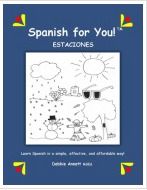
REVIEW: Spanish for You! Estaciones Spanish Curriculum


It's important for children to learn another language. Not only do most colleges expect it, but it teaches them a whole new way of thinking. Other languages work differently than English, and it is a good brain workout! We have struggled to implement foreign language in our homeschool; the girls haven't been terribly motivated and we've had plenty of other things to keep us busy. They took an excellent Spanish class at out homeschool co-op, but they only went twice per month. Foreign language instruction really needs to be more often that that.

I was intrigued when I looked at the Spanish for You! curriculum, and pleased to have the opportunity to review it. Spanish was a good place for us to start, since the girls were a little familiar with it already. We received a physical copy of the Estaciones workbook; downloadable audio files of the entire book, including audio with a native Spanish speaker; PDF downloads of self-correcting worksheets, a weekly lesson guide, and flashcard/activity game pictures. It's a year-long program (24-27 weeks), intended for grades 3-8, and the recommendation is to use it 4 days per week.

Debbie Annett, the author of Spanish for You!, has been teaching Spanish to all ages for 14 years, and was in international business for 8 years before that. She spent time studying in Spain. She wrote this curriculum to be effective, flexible, and affordable, and to work for multiple ages, with or without prior Spanish experience. She wanted to create a program that would flow well into any high school Spanish program. Because each book is written to be used with many ages and levels, they are theme-based, rather than leveled by grade. Currently, there are two books available: Estaciones (Seasons), and Fiestas (Celebrations). A third theme, Viajes (Travels) is available as a short trial unit; the complete package will be available in June 2013.

As we began to use this program, I was a little confused. It's very different from how I remember learning Spanish! I finally decided to STOP trying to remember what little I knew of Spanish and just go with the way the program was written - and I have been VERY impressed.

As a Charlotte Mason homeschooler, I've been trying to learn how Miss Mason would have implemented foreign language instruction. I've heard a lot about Gouin Sequences, and have recently started to learn how they work. François Gouin was a French teacher of Latin who tried to learn German as he had learned Latin - through grammar and translation. Apparently he memorized thousands of German words, translated Goethe and Schiller - all without actually speaking to someone in German - and found he could not hold a conversation with a native speaker. He ended up having children teach him simple phrases, like "Open the door." He found the key to be speaking and interacting with a language.

This is what I found in Spanish for You! Our book, Estaciones, is about seasons. We've learned the days of the week, the months, of the year, and how to talk about the weather, as well as things you can do in each season of the year. From the beginning, we learned to say things that we could put into action - to look at things, to write things, to draw things. Each unit starts out with vocabulary, and making flash cards; then some verbs and conjugating so you can use the vocabulary, and then some grammar, so you see how it all works together. The flash cards are not for "kill and drill," by the way; they are to help the students connect with the words while they make their cards, and then there are several options for activities using them listed in the front of the book. As we've learned more and more words, we've been able to speak to each other in Spanish a bit. We're able to use the language - and that is key to being able to think in it and speak it well.


When we received our downloads, I saved them to the computer, and printed out the 7-8th grade lesson plans and the first set of worksheets. On our first day, the girls made flash cards. They had a GREAT time doing this. I forgot that images were included for the cards in a PDF, so they made their own.


Once the flash cards were made, we moved on to practicing what we'd learned. First, we had just a few commands - "Mira," which means look, "escribe," which means write, and "dibuja," which means draw. With a piece of paper in case they needed to write or draw, I read the commands and they would do them. It got to be more fun when we learned a little grammar, and could ask each other about the weather, what month it was, what the weather was like during a particular month, etc. My girls are at that tween/early teen age when they can't admit to having fun with anything, but *I* enjoyed speaking Spanish with them, and I think they enjoyed speaking it with me, as well.

Ms. Annett offers wonderful support for her program. She answers questions very quickly, and is responsive to feedback. During the review period, she changed how the downloads were organized to make them easier to use. Two things I'd like to see:
  • Worksheets in one file for each grade level, instead of lesson-by-lesson; I'd rather print them out once
  • Answer keys in a separate file
Each level of Spanish for You! is available to purchase as a complete package for grades 3-8 for $64.95, or per grade level (3-4, 5-6 or 7-8) for $39.95. Extra books are available for $12.95 each. With each package, you receive:
  • Soft cover book
  • PDF Download of the 24-30 week lesson guide for the grades you need (Click for sample)
  • PDF download of self-checking worksheets (Click for sample)
  • MP3 download of audio files of the entire book (including bonus audio of native speaker reading the entire book)
  • PDF download of flashcard/activity pictures
This is a great program. You don't need to know any Spanish to teach it - the audio files read everything for you! If you're looking for a simple, affordable way to teach Spanish in your homeschool, I hope you'll consider Spanish for You!

Click here to read more reviews from the Schoolhouse Crew!