Pages

Showing posts with label Science. Show all posts

Tuesday, October 21, 2014

REVIEW: Standard Deviants Accelerate

We were given recently the opportunity to review Standard Deviants Accelerate Homeschool Courses through the Schoolhouse Crew. This was good timing for us, as they have a biology course, and we are studying biology this year. The topics covered in SDA's course videos seemed as though they would go along with what we're studying quite nicely. We received a one-year subscription, with the ability to try out any course, for the purpose of our review.

Standard Deviants Accelerate began more than 20 years ago, when a couple of college graduates came up with the idea of recording core academic subjects on video and making them entertaining for students. They've made some DVDs, and now they offer their courses online. With these web-based courses, students can access them from anywhere - they can use a desktop computer, laptop or tablet, anywhere they have internet access. SDA offer courses in 14 different subjects for students as young as 8 years old:

  • Earth Science (6th grade & up)
  • Nutrition (6th grade & up)
  • Biology (7th grade & up)
  • Chemistry (9th grade & up)
  • Arithmetic (3rd grade & up)
  • Fundamental Math (4th grade & up)
  • Algebra (7th grade & up)
  • English Composition (9th grade & up)
  • U.S. History (9th grade & up)
  • AP Biology (11th grade & up)
  • AP Chemistry (11th grade & up)
  • AP U.S. Government & Politics (11th grade & up)
  • AP U.S. History (11th grade & up)
  • AP English Composition

What did we use?

We used the regular biology program. I had my 8th grader watch the videos and do the lessons.

How does it work?

First, you have to make an account for your student. When they log in, they see their courses:


When you click on your course, you see all the available topics:


Each lesson has a video, vocabulary section, quiz, and a written answer. Some sections have a diagram, such as the ones we saw of an atom and a cell.


Each video is about 10 minutes long. There is a text box available for the student to type notes and save them online. I had  my daughter write notes in her science journal, because there is an important connection between writing something down and retaining knowledge. There is an option to print the full transcript of the video, which I liked; it made it easier to take notes and review the information once the video was over. Also, if you have a child who prefers reading to listening or watching, they will appreciate that feature.

The vocabulary list has an audio clip available for each word, and the list with definition is printable. The diagram has drag-and-drop words to match, and the quiz is multiple choice. Pretty simple.


The "Thematic Question," though... That's a different story. For the biology course, the thematic question was "How does form follow function in biology?" Students are instructed to think about this after each lesson, and answer the questions: "How does the perspective of the thematic question inform your understanding of the topics covered in this lesson?" and "How does what you have learned in this section provide new dimensions to your understanding of the thematic question asked above?". I am not quite sure what to make of those questions myself, much less how to explain them to my students. There is a grading rubric for teachers, but any grading would be completely subjective depending on what the teacher thought the answer to the question should be. The good news is that you can skip that part of the program and it doesn't count against the student's grade.

Grading Rubric for the Thematic Question

What did we like?
  • The videos are a nice reinforcement to our biology studies. I enjoyed watching them. They reminded me of a PBS program - educational and entertaining.
  • The lessons were short, and therefore easy to fit into our school week.
  • I liked having the diagrams of things like cells for the visual reinforcement.
What didn't we like?
  • My daughter didn't care for the way the speakers kept changing, rather than having one person present an entire lesson. She also felt that she was being spoken to as a young child, rather than a teenager. She the information was presented effectively, but she found the presentation "annoying."
  • At the end of each lesson, there is a button that says, "Take Me to the Next Topic." That's great, except that it does not take the student to the work that needs to be completed; it takes them to the next instructional video. When I went in to check my daughter's progress, I could not figure out why it showed 0%, until I realized she'd been clicking the "next topic" button. In order to complete the quizzes for each topic, the student needs to click on the tabs at the top.
  • Grades and progress reports are not available in the same place. You have to look in one spot to see grades, and in another spot to see how far along your student is in the course.
  • Nothing indicates lessons that are completed, and there is no ability to stop in the middle of a video and come back to the same place if you exit out of the page. It would seem logical to have the links at least change color once they have been clicked on, or somehow show that the lesson has been completed, or at least begun.
  • The grading process is not terribly simple, and that's one of the things that tends to draw me to online courses - the grading is done for me, thereby taking something off my plate.
One note: These are secular courses. Evolution was one of the topics in our biology class. I don't have a problem with that, but it's worth mentioning for those who prefer a creationist approach.

Overall, I felt that the biology course was an acceptable supplement. We didn't find this to be one of our favorite online courses, simply because of the somewhat awkward setup. However, if you have a student who is struggling with biology, this would be a good way to reinforce the information they're studying. 

Regular courses are available from SDA for $99 for a year's subscription, or $24.95 per month. AP courses are available for $14.95 per month, per student. They have a special offer right now - through November 15th, you can get a six-month free trial! 


Also, if you'd like to learn more about their programs, click here to sign up for a free webinar, during which a live representative will walk you through all the features and benefits of their programs.

Connect with Standard Deviants Accelerate: Facebook, Twitter, Pinterest, Google+

Click to read more reviews from the Schoolhouse Crew!


Thursday, June 26, 2014

REVIEW: Go Science! DVDs

I've mentioned before that my children love science. It's not really my thing, so it's hard for me to be creative and come up with fun things to do. That's why I love DVDs that teach us how to do experiments, like the Go Science DVDs (Series 2) from Library and Educational Services. I recently had the opportunity to review two DVDs from Series 2: Volume 5: States of Matter, Water; and Volume 7: Engineering, Design, Flight. The recommended age range for these is 4-12 years.

Ben Roy, the teacher in the videos, teaches science methods at the University of Tennessee in Chattanooga, and has also taught school to elementary and middle school aged children. He has done several science video programs, and has a friendly, engaging style that is great for working with children. In each experiment, he invites children to come up and help him. It's obvious he has a passion for teaching and a love for kids. This is a Creation-based series, and at the end of each lesson,  Mr. Roy tells us that learning more about science points us to the Creator. In some lessons, there is more discussion about religion than others.

Each video is about 5 minutes long, so it's easy to fit them into your day. We would watch a video, and then go do the experiment ourselves if Isaac was interested and we had what we needed on hand. Sometimes, my older girls would help us with the experiments, if we needed extra sets of hands.

Volume 5: States of Matter, Water: This DVD contains 12 experiments. My son enjoyed making ice cream and "oobleck." Corn Starch and water always make for a good time, too, and we learned what a non-Newtonian fluid is.

Volume 7: Engineering, Design, Flight: This DVD contains 11 experiments. Isaac liked the "How Much Will It Hold" experiment, because he got to play with dried beans. (Mr. Roy used pasta.) We also had a lot of fun with the centrifuge experiment. What a great thing to do in the summer when it's hot! My son also really liked the Rocket Balloons and the Vinegar Rockets. He thinks rockets are the coolest things ever right now.


What we liked:
  • Mr. Roy is enthusiastic and engaging with children. You could tell the kids had a good time.
  • The videos are short, so no time to get bored, even for wiggly kids.
  • The experiments chosen had pretty dramatic results, for the most part, which is great for getting kids' attention.
What we didn't like:
  • There was no list of supplies needed for replicating the experiments. That would have been handy, so I could have had things ready to go when we finished watching a video. If I were going to schedule these videos into my lesson plans, it would be helpful to know what we were going to need ahead of time for the term. Much of it was stuff we could find around the house, but not all of it.
  • The episode titles aren't listed on the DVD case. You have to pop the DVD in to see what they are. It's a small thing, but I would prefer to have a list of titles somewhere. They could even be on liner notes.
  • My husband, who is an engineer and loves science, felt the explanations behind what was happening were lacking. It seems to me that Mr. Roy tries too hard to keep things simple, and underestimates what kids are capable of comprehending. 
  • I felt that his attempts to bring discussions around to God were somewhat forced. 
Overall, my husband and I felt that these were most appropriate for the younger end of the age range. They could make a nice supplement, but I would most likely use them as a jumping-off point and find a way to add better explanations. The videos were entertaining, but not terribly scientific. They might give good ideas for science fair projects, but you'd have to do more research into the science behind the experiments for your presentation.

The Go Science Series 2 DVDs are available from Library and Educational Services for $8.97 each, or $59.82 for the set of 7.

I love Library and Educational Services. I've ordered lots of things from them in the past, and have been pleased with how quickly I received things and their customer service. I was just as happy with them this time, and will order from them again. I do hope you will check them out. They have great prices!

Connect with Library and Educational Services on Facebook!

Click to read more reviews from the Schoolhouse Crew!


Thursday, April 10, 2014

REVIEW: Supercharged Science


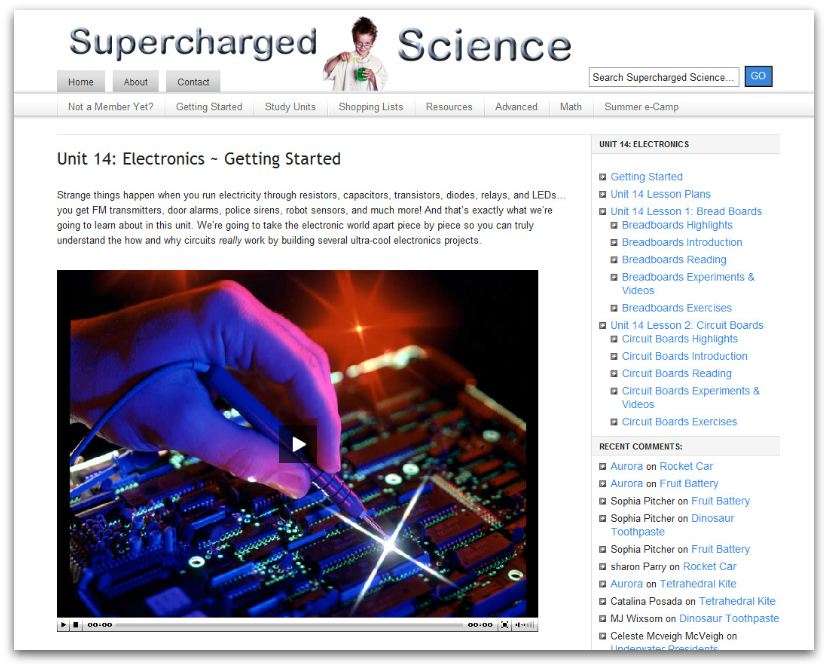
I'm always looking for good science options, so was excited to review the e-Science Learning Program from Supercharged Science. We received a 6-month subscription to the K-12 program.

Aurora Lipper is a real-life rocket scientist with a passion for getting kids interested in science. She started out teaching a group of elementary students about supersonic combustion, then held a science camp, and eventually put together her SuperCharged Science program. She has lots of teaching resources on her site, as well as a homeschool blog, and offers an e-science camp in the summer. She is even available for weekly Q&A sessions on the phone!

There is a TON of information in this program - over 600 experiments! If you look at it all and feel overwhelmed, Aurora has a nice Science Activity and Video Series put together as a place to start. Each one contains five simple experiments with videos explaining what to do.

You can choose to use the e-science program in several different ways: by grade level, by topic, and by interest. You can use it as your primary science program, or as a supplement. They provide "conversion charts" that help you correlate your homeschool science curriculum with the e-Science program. If they don't have a chart for your program listed, they will make one for you if you send them the TOC from your book. (I was excited to see that they offer correlation to Secrets of the Universe by Paul Fleischer, which we used with Ambleside Online last year.)


The topics included in the e-Science Online Learning Program are as follows:
  • The Scientific Method
  • Mechanics
  • Motion
  • Matter
  • Energy (2 units)
  • Sound
  • Astrophysics
  • Chemistry (2 units)
  • Light
  • Electricity
  • Magnetism
  • Alternative Energy
  • Thermodynamics
  • Electronics
  • Life Science (2 units)
  • Biology (2 units)
  • Earth Science
  • Award-Winning Science Fair Projects
  • Mathemagic
They're working on adding even more hands-on worksheets for advanced students, which will be equivalent to college and real-life science work.

We decided to do delight-directed science this time, and selected some I knew everyone would enjoy, even my 6-year-old. All three of my children really enjoyed the experiments we chose. My girls, at 13 and 14, are old enough to try most of them on their own. One fun and simple activity was the Microwaving Soap experiment in the "Solids" section of the unit on Matter. I had never done it before, and it was fascinating to see what happened. I only bought three bars of soap, which was probably a good thing because otherwise I'm pretty sure we'd still be trying different variations! As you can see from the pictures, I had a captive audience.

There is a lot to love about this program. You're intended to do experiments first, then learn the "why" behind them, which is the best way to learn science. Students are encouraged to keep a science journal with their hypothesis and results, which has been a lot of fun for us. There are is something for every age, and you can have all your children working on the same topic with age-appropriate material. I love having the experiments available to use alongside whatever science we have, and it would also be an excellent stand-alone science program. Most of the supplies needed are common household items, and if they're not, links are provided for ordering online. The only real drawback is the cost. The monthly cost is a significant chunk of our homeschool budget, and while science is obviously important, it's not the only important thing.

The e-science Premium Membership is available for $57 per month for grades K-12, or $37 per month for K-8. When you sign up, you're given access to 1-2 levels per month, but if there's a topic you'd like to cover and you don't have it yet, you can just email them and they will get it set up for you. Note: because this is an online program, there are some technical requirements you'll want to check.

If you'd like to see what using Supercharged Science is like, click to sign up to receive a free copy of Aurora's Science Activity Video Series and Guidebook. Also, Aurora is offering a fantastic special: try e-Science for one month for only $1! Click here to find out how to take advantage!

Connect with Supercharged Science on Facebook, Twitter, YouTube, Pinterest, and Google+. Don't forget to check out their blog!

Click to read more reviews from the Schoolhouse Crew!


Wednesday, March 12, 2014

REVIEW: Amazing Science DVD

My little man, who is currently 6 years of age, loves to do "experiments." If I don't have an actual science activity for him to do, he makes up his own. That can get messy. I'm not the greatest at coming up with experiments, to be honest, so I was delighted to have the chance to review Amazing Science, Vol. 1 from ScienceandMath.com. I received a physical copy of the 2-DVD set to review. There are 23 different videos, covering such topics as electricity, magnetism, heat, and more.

This DVD set is aimed at grades 1-3, but these science experiments are great for any age, really. I hadn't done most of them before, and I enjoyed them quite as much as my son! He would get the DVD and pop it in every day, to see what we were going to do next.

Mr. Jason Gibson is the scientist who presents the experiments.  He has degrees in physics and electrical engineering, and was actually a rocket scientist for NASA! In each video, Mr. Gibson gives the materials list, shows the complete experiment, and explains the science behind what you're doing. I had to laugh at Isaac; he had no interest whatsoever in the explanations and really just wanted to get on with the cool part. I, on the other hand, learned a lot and had a great time!

When we did the first experiment, "Color-Changing milk, I went and got whole milk (recommended in the video), and then we set to work. I was amazed at how carefully Isaac did exactly what he had been shown in the video. He *loved* that experiment, even though I only had yellow and green food coloring for the first run. He got to mix it all up and make "green milk" at the end, which he thought was fantastic. He enjoyed the experiment so much, we had to do it again when Grammy and Papa were visiting so they could see, too. (It was a bit of a trick to find non-gel food coloring. I located it with the spices, rather than with the cake decorating things, FYI.)

Check out this video of the color changing milk experiment:


The next experiment we did was "Egg in a Bottle." My husband was home to help with this one, which is always fun. We lit the matches, dropped them in the jar, placed the hard-boiled egg on top, and watched it squish itself right down into the bottle, even though it clearly did NOT fit through the mouth of the bottle before dropping the matches in there.  We actually did this experiment several times, because my science-loving husband knew if he blew really hard into the bottle, he would reverse the process and force the egg back out.  We have done it again since, too, which has resulted in us getting to eat a lot of deviled eggs, because I'm not going to boil just one egg at a time!

Another fun one was the "Floating Egg" experiment. This one was so simple, and yet did a great job illustrating buoyancy. Mr. Gibson explained how the salt dissolved in one glass didn't really go away, so the water in there weighed more. Because it weighed more, there was a stronger buoyant force pushing back against the egg, so it was able to float. Simple, but fascinating!

The experiments shown on these DVDs are my idea of fun, living science. You get to see how the experiments work, with clear, simple explanations. I watched the videos with Isaac, but in the future, I might set them up for him, let him run them (with help as necessary), and have him narrate what happens. Then, we can watch the videos and hear the explanations. The supplies you need are readily available, and if you don't have them at home you can find them easily. It's fun to go through the experiments sequentially on the DVDs, but you could also use the DVDs as a resource and pull out experiments to go along with whatever science program you're using. My girls enjoyed doing these experiments with us, and they are old enough (12 and 13) to do the experiments on their own and keep a science journal with the steps and results. My girls were able to do these with my little man, too, and they all enjoyed that. I could see this being a great resource for co-op situations, as well.

Amazing Science Vol. 1 is available from ScienceandMath.com for $17.95, and as a digital download for $14.99.

Click to read more reviews from the Schoolhouse Crew!


Sunday, November 10, 2013

REVIEW: Chemistry & Physics, Apologia


Apologia Educational Ministries, a well-known publisher of many different homeschool resources, has just released their latest science program in their Young Explorers Series:  Exploring Creation with Chemistry and Physics. We received the following items:

The Notebooking Journal is appropriate for upper elementary students, in approximately 4th-6th grades. The Junior Notebooking Journal is intended for younger elementary students, approximately K-3rd graders, who haven't quite mastered handwriting. The junior journal includes coloring pages or other activities instead of some of the writing assignments, and elementary handwriting lines for copywork.

The notebooks include lesson plans, which schedule 2 days of lessons per week, for 28 weeks of lessons. The first five lessons cover chemistry (topics include matter, atoms, compounds, and mixtures), and the remaining 9 cover physics (motion, energy, sound, light, thermal energy, electricity, magnetism, and simple machines). The book is written in a conversational style to the student, which all my children enjoy. It's so much nicer than reading a traditional textbook!

I chose to read the textbook aloud with all three of my children, and then have them narrate the reading and discuss what we'd learned. Then, we worked on experiments. I found the lessons as scheduled to be a bit lengthy for my 6-year-old. It worked better for us to break the lessons into 4 days most of the time. Also, my son wasn't quite ready for the junior notebooking journal, because he doesn't like to color and doesn't write at all, so we set that aside. We all enjoyed the experiments, though! I'd have to say my favorite was the density experiment, in which we poured several different liquid substances (honey, corn syrup, maple syrup, whole milk, dish soap, water, vegetable oil, rubbing alcohol) into a tall, thin vase and dropped different objects (a game die, a popcorn kernel, and a grape tomato, for example) into it to see where they stopped. We all formed a hypothesis for where we thought each object would land, and were surprised by the results! (The tomato stopped in the dish soap. I really thought it would sink to the bottom!)

While the notebooking journals are not required to use the textbook, they are a really nice addition to the program. First of all, all the pages are nicely spiral bound, which means children can't lose them. How many times have we started a binder, only to have papers spread about the house? I don't think I will tell you, actually, because that would be so embarrassing! There are also additional activities in the notebooking journals if your child is interested in pursuing the topics further. The activities are the same in both the junior and regular notebooks. Example: for Lesson 3, "Building Blocks of Creation," one of the suggested activities is to make a memory game out of the first 100 elements in the Periodic Table. You put the symbol on one card and the name on the other, and then try to match the symbols to the names. What a great idea! Mrs. Fullbright also includes book suggestions for each chapter for supplemental reading.

There is a link on the bottom of the Apologia site called "Book Extras." In the front of the textbook, there is a password which allows you to gain access to information related to the page of Chemistry and Physics links and printables. There are links to various activities and videos correlated with each chapter in the book for further exploration. There are some free notebooking pages if you'd like your student to have some structure for creating their notebook, or just want to try out note booking before you decide if you want to purchase the journal.

One thing I love about this curriculum is the way it presents concepts to elementary students so that they understand, but are not "dumbed down." In lesson one, we learned about the difference between mass and volume, and I thought the illustrations were excellent. First, we saw a picture of two loaves of bread, both with exactly the same ingredients, but for some reason, one had risen but one had not. They both had the same mass, but clearly not the same volume. Another example showed one girl with smooth, straight hair next to a picture of a girl with very curly hair. No question which hair had more volume! Along with narration, which is key to students making what they learn their own, the activities and experiments do an excellent job of illustrating the concepts and helping students understand the "why" of what they're reading. I enjoy learning along with my children so much, and it's always a joy to discover something that helps me teach them in such an engaging way.

This was our second experience with Apologia's Young Explorers Series, and I really am impressed by how well this curriculum is put together. As a Charlotte Mason homeschooler, I know there are many, many living science books out there, and for me, it's worth seeking them out and putting things together for myself. However, sometimes there just isn't time, or life intervenes, and it's a tremendous blessing and time saver to have someone else put the plans together. Apologia offers a wonderful homeschool science resource.

Click to read more reviews from the Schoolhouse Review Crew!


Sunday, April 14, 2013

REVIEW - Supercharged Science


Have you ever heard of Supercharged Science? I have heard a great deal about this company over the last few years, and have been itching to try their e-Science program. Aurora Lipper, author of the program, has a Master's degree in mechanical engineering, taught as an instructor at Cal Poly State University and worked at NASA on rockets and jets. She is a ROCKET SCIENTIST - for real! She was struck by how bored students were with science, and couldn't understand it - until she learned how most of us are taught about science in school. She set about creating her own lesson plans for science, and after teaching her first lesson to a group of local elementary students with great success, she went on to have a science camp. All this gradually evolved into Supercharged Science - a program that is fun for children and easy for adults to implement.


Aurora's approach is to teach science "from the inside out" - let children do some experiments, see how cool the results are, and then teach what's behind it all once they are hooked and excited to learn more. You don't just throw supplies at them and let them have at it, either. She encourages students to keep a science notebook, and carefully record what they do along with their results. She teaches them how to work with the scientific method and do things correctly. Here is a list of topics covered in the program:

Scientific Method Energy Light Thermodynamics Earth Science
Mechanics Sound Electricity Electronics Science Fair Projects
Motion Astrophysics Magnetism Life Science Mathemagic
Matter Chemistry Alternative Energy Biology


Would you like to see some of the things we did? I knew you would! Let's take a look, shall we?

We started out with the Scientific Method unit, because we've done very little formal science and I don't believe we've ever discussed it. The first thing they did was see how many drops of water would stay on top of a penny before it all splooshed out. Using an eye dropper, they counted the drops as they went along. It was interesting to note that Emma got quite a few more drops to stay on her penny than Abbie did.


After that, we decided to start with Unit 1, Mechanics: Force, Gravity and Friction. We had most of the supplies around the house, so it was a good place to begin. First, we read together the unit overview, vocabulary words, and text, and then I had them do some experiments. First, we looked at magnetism.

I decided that we would look at eletromagnetism using a balloon and a cat. Aurora didn't tell us to do this experiment, I promise, but it was a great deal of fun and we laughed a LOT. (No cats were injured while a balloon was stuck to them.)


Then, we went outside with a compass. I have never used a compass, and wouldn't know how to get myself anywhere with one, but they work because the magnet inside can detect the earth's magnetic field, and it makes the needle in the compass always point to the north. (The experiment was to show us that the earth *has* a magnetic field, not to understand exactly how a compass works.)


We also looked at magnetism in o-shaped cereal. It turns out that if you put some of the cereal in a bowl and stir them around so they have to move away from each other, they attract back together into a group.

Next, we took a look at gravity. This was highly entertaining for me. First, I had the girls jump into the air to see if they would come back down. Guess what? They DID! I had them repeat this a few times to make sure our hypothesis was sound. Then, we tried it with a rubber ball, and learned that, indeed, gravity still worked.

Gravity works! :-)
We moved on to find out whether an object thrown horizontally will fall at the same rate as one that is dropped (it does, much to my surprise), and then did another experiment to see if weight figured into the equation (it doesn't seem to - opposite of what I thought). These were all simple, but we had FUN while we were doing them, and they had to think about what was happening and why. After we did the experiments, we completed the corresponding exercises in their science journals.

The way the program works is this: you sign up for a monthly subscription, which costs $37 per month for grades K-8, or $57 per month for grades 9-12. For the first month, you are given access to the first seven units: Mechanics, Motion, Matter, Energy 1, Energy 2, Sound, and Astrophysics. Each month after that, you will receive access to two more units, in the order given on the website. If you see something else you want to try sooner, you can email them directly and they will give you access. Also, they have conversion charts available that show you how you can use the program in conjunction with several popular homeschool science programs. As you consider signing up for the e-Science program, be sure to read their terms of service (as you would for any other subscription program). They do have a 30-day satisfaction guarantee. If you'd like to try it out before you subscribe, you can sign up for some great free stuff and try it out.

There is a TON of information on this website. It feels a little overwhelming at first, actually. However, once I took a deep breath and started really looking at what was available, I was impressed. I like that there is so much hands-on learning to engage a child. Even the "textbook reading" is very well done - it's written in a conversational tone to the student. Aurora Lipper is passionate about science, and it shows in all aspects of the program. She is also available to answer any questions you may have.

The girls and I *loved* using this program. It really is accessible for all ages. There was a lot that Isaac could do and understand along with us. They appreciated the hands-on learning and looked forward to doing science. This program is a great example of living science and worth considering for your homeschool.

 Click here to read more reviews from the Schoolhouse Review Crew!

Sunday, February 10, 2013

REVIEW: Apologia Anatomy & Physiology


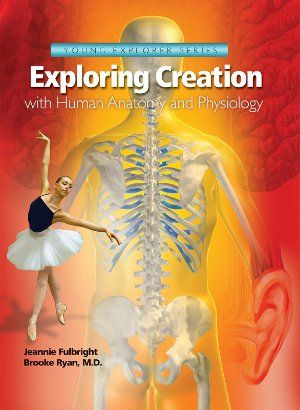
When the chance to review Apologia Educational MinistriesExploring Creation with Human Anatomy and Physiology curriculum arose, I was intrigued. We haven't used any of their books before, but I have heard many good things about them from homeschooling friends. We use Charlotte Mason's principles in our homeschool, and I had heard that the Apologia books would work well with the approach while providing the structure of a textbook.

Apologia's textbooks are quite different from anything I ever read in school, and are written to the student in a narrative style, rather than simply presenting facts. The books are written with Charlotte Mason's philosophy in mind, incorporating narration and notebooking activities. The Young Explorer series, directed at elementary students, follows the days of creation in its topics: astronomy, botany, flying creatures, swimming creatures, land animals, and finally, human beings. Apologia is a Christian company, with lots of resources available in addition to their science products.

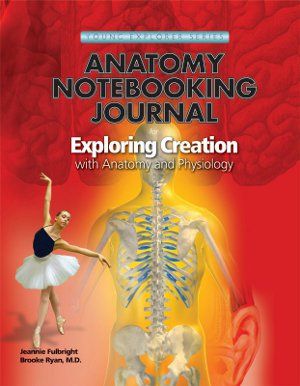
The publisher offers the following items with this curriculum: the  Human Anatomy & Physiology textbook, $39.00; Anatomy Notebooking Journal, 4-6,  Anatomy Junior Notebooking Journal, K-3, $24.00; and the Human Anatomy & Physiology MP3 Audio CD,  $29.00.  There is an optional Blood Typing Kit, good for one student, available for $14.00.


For the purpose of this review, I received a copy of the Human Anatomy and Physiology textbook, regular Anatomy Notebooking Journal, and MP3 audio CD. I did purchase an extra Notebooking Journal so my girls would each have one. The Young Explorers series is generally for children in grades K-6, but Apologia does recommend Anatomy & Physiology for upper elementary students, 4th-6th.

The textbook is a nice hardcover, which I love. There are 14 lessons, and they are designed to be done over two weeks each. The topics covered are:


1. Introduction to Anatomy and Physiology
2. The Skeletal System
3. The Muscular System
4. The Digestive and Renal Systems
5. Health and Nutrition
6. The Respiratory System
7.  Life in the Blood
8.  The Cardiovascular System
9.  The Nervous and Endocrine Systems
10. The Nervous System Extended
11. Your Senses
12. The Integumentary System
13. The Lymphatic and Immune Systems
14. Growth and Development


The notebooking journals come spiral-bound, which works well for writing and drawing in them. They also contain the schedule, directing them to narrate what they read, which makes sure we discuss their readings. The schedule also has all activities clearly listed, so you know if there is an experiment to do, etc. There are lots of fun activities: drawing, crossword puzzles, mini-books (like you'd use in a lap book, but they go in the journal) and - EXPERIMENTS! See below to check out some of the fun we had.

Because the CD contains an MP3 audio book, you need an MP3-compatible CD player, or you can play it in your computer. For a PC, there is an auto-run program. On a Mac, you double-click on the CD icon and then double-click on the MP3 file you'd like to hear. I love having an audio book to go along with the text. One of my girls gets headaches from reading (we're working on finding a solution for that), so having the option available for her to listen to her assigned pages is wonderful.

We enjoyed doing the projects together. First, we learned how to mummify an apple, to show us what happens when you mummify an organ. We made a mixture of salt and baking soda, and put one peeled apple into that, and left the other one open to the air. We looked at them a week later, and see what happened? The smaller, darker one on the left is the mummified apple, and the one on the right is our control apple.


Then, we learned about cells, and all those nifty organelles that live and work inside them. This time we got to make our own model cells with Jell-O and candy.  It was a good time to review the function of each organelle, and remind us what they looked like as we compared them to the candy we used to represent them in the Jell-O.


The best part was, once they were finished, they got to each all that delicious (?) candy and Jell-O. I believe that was Isaac's favorite part. 

My girls, who are 11 and 12, have learned a lot during our time with this curriculum. Apologia's book is well done for its intended age group of older elementary, 4th-6th grade. It's written to the student, so they have the schedule and can read on their own. I would love to be able to read everything with them snuggled up on the couch with me, but with a very busy 5-year-old boy in the mix, that doesn't happen as much as I'd like. I was able to utilize the CD to keep up with what they were reading. I found the notebooking journal to be a valuable addition, because it keeps all their work in one place. We've had some difficulty keeping track of our studies in binders during previous studies. I've been able to have the girls read on their own, narrate to me, and then have us all meet at the table or in the kitchen for the activities, since Isaac enjoys being a part of those as well. 

If you're looking for a gentle, easy-to-follow science curriculum, I recommend taking a look at Apologia. I will be looking at some of the earlier books for use with Isaac, when we start more formal school with him next year.