Pages

Friday, March 22, 2013

Nature Study - Another Attempt

This school year, my friend Sara and I are enjoying our little Charlotte Mason community, which consists of our two families. She has 5 children and I have 3, so we have a good little crowd, although technically only 4 of them participate in the majority of the activities.

One thing we're working on perfecting, or at least improving, is nature study. I am not quite sure how to implement it correctly, so we've tried a couple of different things. We chose birds as our first topic, so I tried having us study things like different beaks, different wing types, etc. That wasn't a huge success. We tried spending our time outside at Sara's house, because they have a few acres out in the country. Sometimes we found things to draw, but mostly the kids wanted to play by the time we got out there since it was the last thing in our schedule for the day.

This term, we're trying a different approach. We are discussing specific species of birds we are likely to encounter in our area, and drawing pictures of our "bird of the week" in our nature journals. This has worked well, and we've all noticed that we learn the markings of each bird pretty well, because we have to pay close attention while we work on our drawings. Both families have bird feeders, so we've been able to observe our birds in action. Good stuff!

We also decided to take one week per month and go to a local park and observe nature in each season. This was our first sojourn to Bakers Mountain Park, a local wildlife preserve with hiking trails and bird feeders. They even publish a list of birds you're likely to see there, so you can look for them when you visit.

We managed to scare all the birds away today. :-) The kids were all so excited to go on a hike, we spent very little time actually observing anything, and certainly no attempt was made to be quiet so the birds might let us see them. There was lots of tree-climbing and running. I'm giggling just thinking about it; they were so full of joy, it wasn't in me to rein them in this time.

Tree Climbers
It reminded me of my first nature study class in a different co-op. I sent the kids on ahead on a little trail, thinking I'd need to follow behind to make sure we didn't lose anyone. I learned that, in fact, I needed to go first, because they all sped through the trail, chattering merrily, and observed not one thing on the walk. One memorable quote was, "I saw some trees." (We walked through woods.) After that, I went first, and modeled observing things for them.

We had a similar experience today. I actually took my backpack with nature guides, binoculars, a little magnifying jar, our journals, pencils and colored pencils. This turned out to be unnecessary. Some of the boys did notice some really cool moss that felt just like carpet, but of course, I don't have a nature guide to identify moss so we weren't able to learn anything more about it. When we got back to the picnic tables, and I asked the kids if they'd observed anything cool, no one had anything to say. One child, who shall not be named, actually said, "We didn't see any nature!" Both Sara and I laughed and laughed that. I threatened to call the Charlotte Mason police. Oh, my goodness - we had just spent quite a long time hiking through a beautiful area, and there was nothing to see?!? The child in question did specify that we were looking for birds, and we hadn't seen any. We did hear tufted titmice singing throughout the day, though, and we were finally able to identify the song thanks to our handy iBird app.

Next time, I will make it clear that we are going on a NATURE WALK and that we are going to OBSERVE NATURE. It will most likely require a more concerted effort to be quiet (something at which we don't excel quite yet) and less running. It's a little challenging with our very small peeps, but we can work on it. After all, they are future nature students too!

Do you know that one of my children said to Sara, "Never let my mom go on a nature walk. She takes forever." Sara, bless her, responded, "Could it be because she's actually looking at things?" Hee! In spite of our spring fever, we saw some cool stuff today. Check out what we think might be a woodpecker tree:

Woodpecker Tree?
I'm not sure what did that to the bottom of the tree (picture on the right). Any thoughts?

We also saw lots of lichens and mosses - my favorite things to find in the woods - and I'm pretty sure we found wild ginger! That was a first for me.

Lichens, Moss, Wild Ginger
There was also a tiny stream running across the trail. Pretty sure all the littlest ones splashed in it. Naturally, the park's website says no wading is allowed in streams. Well, then, it's pretty silly to have one running right across the trail, don't you think? What little person could resist a splash or two?

Tiny stream across the trail
We had a wonderful time today. We went on quite a hike - we chose the hardest trails, I learned, upon reading the website after we got home. The kids got lots of exercise (as did the moms) and we got to know a little bit about the park. Our hope is that as we spend more time there, we will become familiar with this park in all seasons. I have hope for us.

REVIEW - The Art of Poetry

Older (age 9?) children should practice reading aloud every day, and their readings "should include a good deal of poetry, to accustom him to the delicate rendering of shades of meaning, and especially to make him aware that words are beautiful in themselves, that they are a source of pleasure, and are worthy of our honour; and that a beautiful word deserves to be beautifully said, with a certain roundness of tone and precision of utterance. Quite young children are open to this sort of teaching, conveyed, not in a lesson, but by a word now and then."
- Charlotte Mason, Home Education, p. 227
I've mentioned before that I wanted to add more poetry into our homeschool days this year. When I thought about what I knew, I had vague memories of learning about poetry in fits and starts throughout high school and college. In fact, I still have my college poetry book. I knew I wanted my kids to learn about form and meter and "stuff," but left to my own devices, I had no idea where to start or what to teach.

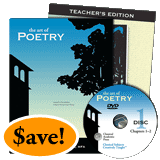
Thus, I was pleased to receive a copy of Classical Academic Press' The Art of Poetry curriculum to review. I received a copy of the The Art of Poetry Teacher's Edition, a copy of The Art of Poetry Student Text, and a DVD with the first two lessons from the Art of Poetry DVD Set.The course is intended for children in middle school through high school.


The goal of The Art of Poetry is to teach students to read closely, to develop a relationship with the poems they encounter. As I learn more about Charlotte Mason's principles of education, I see that children are taught to be close observers of life, of creation. Charlotte Mason said that "education is the science of relations," and Christine Perrin, the author of this program, says that "reading a book is like learning to listen to another person--we have to work to listen and to understand to the best of our ability based on our own perspective and experience." (p. xiv, Introduction to the Teacher) I love this quote from Miss Mason's book, Ourselves, the only volume of her 6-book series written to children:
"There are libraries, too––such libraries! containing every book of delight that ever was written. When anybody sits down to read, the author who made the book comes and leans over his shoulder and talks to him. I forgot to say that in the picture-galleries the old painters do the same thing; they come and say what they meant by it all." 
- C. Mason, Ourselves, Book 1, p. 3
Do you not love the image of your favorite authors leaning over your shoulder, sharing their thoughts with you? I know I do (and I would especially appreciate it if some of the painters would clue me in, too, but that's a topic for another day).

All that to say, I felt a connection with Ms. Perrin and her goals for her poetry program. She states that "literature is asks us to come into relationship with it in such a way that we might be changed and instructed in the way in which we conduct our lives." She then says that "interpretation aids this process. However, writing a teacher's guide that provides interpretations of poems is risky. The concern is that you might not mine the poem yourself if the silver is already there for the taking." (p. xii, Introduction to the Teacher) I appreciate that she knows the danger of simply telling students what a poem contains - she cautions us to be sure we seek and find for ourselves. I believe Miss Mason would have applauded that.

Now, on to the review! There is a *ton* of information in this program. It is organized into three main sections:
  • The Elements of Poetry:  images, metaphor, symbols, words, sound, rhythm, shape (stanza and line) and tone (putting it all together)
  • The Formal History of Poetry: including history of form, movements, genres; verse forms; shaping forms; open verse; and an anthology of narrative poems (see the table of contents here)
  • Application: growing your interest, perhaps with a writer's journal, a notebook of favorite poems, or starting a poetry group, along with many other suggestions
Each chapter in the student book includes an anthology with discussion questions and vocabulary words for each poem, as well as a list of activities. The Teacher's Edition includes everything from the student book, as well as explanations and answers that go along with questions for each poem, and a poetry timeline. Both the teacher and student books have a section with short biographies for each of the poets covered.  There are some great online resources for the course as well: Christine Perrin keeps a blog called The Art of Poetry Online, which includes many teaching helps; audio files of readings of some of the poems from each chapter you can download; and suggested weekly schedules of  different ways you could choose to work through the program.

My girls and I started using the course by watching the first DVD lesson on Imagery. We enjoyed it very much, particularly because the chapter includes a poem by Robert Frost (my favorite poet). I had them work on a couple of the activities, including writing out images for each season, figuring out which of our 5 senses was the most important to us, and discussing images that are important to us. We read the poems in the chapter together, and really enjoyed discussing the images in them. I love Robert Frost's poem, "Dust of Snow," because of the image it creates in my mind. It was a great exercise to verbalize that mental picture.

The second chapter covers metaphor. We love several of the poems in this chapter! "Hope is the Thing with Feathers" by Emily Dickinson is dear to my heart. "Nothing Gold Can Stay" is my very favorite Robert Frost poem, and the discussion questions helped me see things I hadn't before. We also read "I Wandered Lonely As A Cloud" by William Wordsworth, which is a poem Emma loves. It was such fun to look at both beloved and new poems in a new way as we sought out metaphors!

While we did enjoy the DVD lessons, the second one on metaphor was VERY long. We tried to watch it all in one sitting, and in retrospect, we should have watched a poem or two per day and discussed them, rather than trying to absorb them all at once. I found the DVDs to be quite useful, hearing others read the poems and discuss their impressions. It's helpful to see how others analyze poems while we're learning to do it ourselves.  

I am not a "poetry person," if you know what I mean, but I am a poetry wannabe. I am getting every bit as much out of The Art of Poetry as my children are, and I'm enjoying every minute. It's certainly challenging us. We are working our way through the material slowly, so we can learn without overloading our brains. I really like the suggestion in the book of spreading it out over more than one year, because there is so much information to process..

Whether you are a poetry lover who wants to share that passion, or a wannabe like me who hopes to foster a love for poetry in herself and her children, you will find The Art of Poetry to be a valuable tool on your journey. The girls and I are already able to see things in our daily poetry readings that we didn't before, and I look forward to creating our own personal personal anthologies and increasing our knowledge with this program.

You can purchase The Art of Poetry directly from Classical Academic Press:

The Art of Poetry Student Text, $24.95
The Art of Poetry Teacher's Edition, $29.95
The Art of Poetry DVD Set, $69.95
The Art of Poetry Bundle, including student text, teacher's edition, and DVD set, $99

Click to read more reviews from the Schoolhouse Crew!


Tuesday, March 19, 2013

REVIEW: Essentials in Writing, 6th Grade


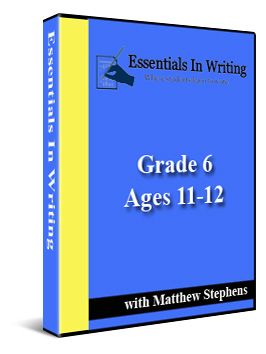
I am a bit obsessive about homeschool curriculum, and I have read about many, many writing programs, but I had not heard of Essentials in Writing before having the opportunity to review it.  It's a complete language arts curriculum, and is available for grades 1-12. I was pleased to receive a copy of Essentials in Writing 6th Grade, and I used it with Emma (7th grade) and Abbie (6th grade).
Essentials in Writing is set up with grammar lessons for the first part of the book (lessons 1-25 in the 6th grade program), and then writing lessons for the remainder (lessons 26-68). There is a video to watch for each lesson, taught by Matthew Stevens, who was a middle school teacher before developing this writing curriculum. I found his lessons to be clear and engaging, and my girls enjoyed them as well. You can see a sample 6th grade lesson here. The recommended approach is to have students look at the day's worksheet, then watch the video and complete the assignment. Once they're done, they should look over the next day's lesson so they're aware of what's coming next.

The 6th grade book covers the following topics (you can download the scope and sequence here):
  • Sentence types and structure, addressing sentence errors as well as dependent and independent clauses
  • Capitalization rules
  • Punctuation rules
  • Grammar:  subject/predicate (both complete and simple, and compound subjects/predicates), parts of speech, subject/verb agreement, propositional phrases, appositives
  • Spelling rules for plural nouns
  • The mechanics of dialogue
  • Figurative language
  • Parts of a paragraph & Writing a paragraph
  • The writing process: pre-writing, drafts, revisions, editing/publishing 
  • Writing a personal narrative
  • Writing an expository essay
  • Persuasive writing
  • Writing a summary
  • Compare/Contrast
  • The process for writing a research paper
  • Poetry (text features/end rhyme, free verse and composition)
My two favorite things about this program are (1) the DVD lessons take me out of the equation for the most part, which is very helpful with a busy 5-year-old in the house and (2) short lessons, so that even when there is a project that will take longer to complete, it's broken into bite-sized pieces so it's not overwhelming. One thing I wished for while we were doing the grammar lessons was an answer key, because every now and then I wasn't 100% sure of the correct answer, and while I was flipping through workbook to write my review I found it in the back. Aha! The good news is, the girls made enough mistakes that I know they haven't discovered it yet for themselves. :-)

Both girls enjoyed using this program. Well, the younger one said she didn't mind it, which means she liked it a lot. :-) The older one felt that it was easier to understand than the other program we'd been using, and I attribute that to the DVD lessons. She also said she would not complain when we continue to use it. That's some high praise from my "tweenagers," I assure you.

I did learn while working through this program that my girls really need practice reading directions and completing an assignment by following a given example. We've done informal grammar instruction up to now, and our writing has been primarily copywork and narration, so they have not done many worksheets. Once they did their EIW lessons, we went over them together, and that made for some good discussions. When I pointed out mistakes, they were able to see what they'd done incorrectly right away, and I hope it's helped them see that reviewing their work before turning it in is a good idea.

Each level of Essentials in Writing is $40. You will receive two DVDs with the lessons, and a PDF copy of the workbook via email. It's a good-sized workbook, and they also have a pre-printed Optional Workbook available for $20 if you'd rather not do the printing yourself. When I had questions, I received answers quickly and appreciated their customer service.

I like this curriculum. I like that both grammar and writing are taught, and how each year builds on previous knowledge. I love that poetry is included! It's a great program at a great price. It's definitely worth checking out!

Click to read more reviews from the Schoolhouse Crew!


Monday, March 18, 2013

REVIEW: TouchMath


My little guy turned 5 in August, so even though I would not have sent him to school this year, if we were going that route, we've done some kindergarten work. Overall, it has not been going well. He doesn't want to sit still, and has strong opinions about whether or not he should have to do any school work at all. It's not that he can't do it; he's quick to grasp things, and once he decides to cooperate, it goes quickly. I do spend quite a lot more time getting him to do the actual work than he spends doing it, though.


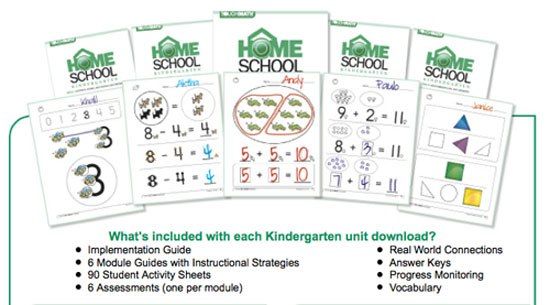
I've been revising my plan over the last few weeks, and felt it was best to pare back to some reading instruction and a little math. When the opportunity came to review TouchMath, I was excited to use it with Isaac. We were both thrilled to receive our box, and quickly got everything out to play. For the purpose of this review, I received downloadable versions of all 4 TouchMath Kindergarten Homeschool modules, A-D. There are 6 units within each module.

  • Module A focuses on Counting, Adding and Subtracting within 5
  • Module B focuses on adding and subtracting within 5
  • Module C focuses on understanding numbers 1-20
  • Module D focuses on measurement, data, and geometry. 
In addition to the core program, we also received the following fun manipulatives to use:  TouchMath Tutor Kindergarten Software, TouchShapes,


and 3-D Numerals. Note: The manipulatives are optional, and not required to use the program.


Isaac *loved* all the manipulatives. We started out with learning the touch points on the numbers, and he caught on quickly. He liked to get them out and practice on his own. He enjoyed using the TouchShapes during the lessons, and liked using them to make pictures on his own. He's always up for a game on the computer, and he liked having a special math game just for him.

"Mommy, is this a rhombus or a  hexagon? Very good, Mommy!"

One of the first things we did was learn to count to 100. I remember practicing this with my girls when they were older than Isaac, so I wasn't sure how it would go, but he caught on lickety-split. I loved how the worksheets had him start counting in a random place and continue from there, or fill in numbers in the middle of a sequence. It made him think about the numbers, and he did very well. 

 Counting to 100 - fun with Cheerios!

As we got a little further, I thought some of the activities were a bit simple. I didn't see why he needed to circle groups of shapes, for example, until I remembered from the teacher training video how crucial it is to connect manipulatives and pictures with the abstract numbers. By circling groups of 2, he is learning to see what a "2" means.


TouchMath recommends using the program for 2 - 2.5 times your child's age, which would be 10-12 minutes per day for my 5-year-old. On a typical day, we would try to work on a set of activity sheets, which were in sets of 2-4 pages in the  Implementation Guide. Sometimes, we got them all done, and other times, we might get through one. He liked the computer software, so I encouraged him to practice on that, and he was almost always willing.

As we began to use the program, I was concerned that I was missing something. I had read the teacher's instructions, but didn't feel I had quite enough information. I confess that I am an anxious math teacher. I went to the website and ordered their free teacher training DVD, even though I wasn't sure I'd get it in time for the review. It arrived via Priority Mail in just a couple of days! I was thrilled with the quick turnaround. I watched the DVD, and it was very helpful. They also included a "Teacher Training Manual," with much of the information presented in it, and practice problems for each thing presented. It was excellent, and I felt much more confident after I'd viewed it.

I have been impressed with their excellent customer service. I had a question about the software, and was able to get an answer quickly. Also, we had an issue with one of our manipulatives, and they sent us another one right away free of charge.

I really, really like this program. I love the statements that children are given to memorize, like "I start on the side with the arrow. The arrow is in the ones column on the right side." Also, for addition with regrouping, they put a box over the next column, and for subtraction, they use a "regrouping bar," which is a line, instead. My girls were often confused with regrouping and would add instead of subtract, etc. Those visual cues are excellent.

TouchMath was created because an elementary teacher saw her beginning math students having difficulty, and wanted to help them. The focus was initially on students with special needs, but has grown into a math program for anyone. I love this quote from their website: "During the next thirty years, our goal is to help banish math anxiety worldwide, whether that anxiety is born of fear, lack of comprehension, or a learning disability." I have a daughter with quite a lot of math anxiety, and I wish I'd known about this program when we were starting our math journey. I think it would have made a huge difference to her.

I've spent a lot of time stressing over math in my homeschooling career, and while using TouchMath, I felt I could teach it successfully for the first time. The way they explained the concepts made so much sense to me, which made it easy to explain to Isaac. I was amazed at how quickly he learned things while using this program.

Product Pricing:
TouchMath Homeschool Kindergarten Modules, A-D: $59.95 each, or $199.00 for all four
TouchMath Tutor Kindergarten Software, $99 
TouchShapes, $30
TouchMath 3-D Numerals, $79

Click to read more reviews from the Schoolhouse Crew!


Friday, March 15, 2013

What's For Dinner?

We often have pizza on Fridays, but tonight we're having something different. I thawed a top round/London Broil yesterday, intending to have it last night, but I'd forgotten that it's not the best choice for grilling. I'm putting it in the crock pot this morning, instead.

I thought I'd share the recipe. It's one of my family's favorites, and it's nice and easy. I'm not sure where I got it. I think it came from a bunch of homeschool moms sharing recipes online, as we are wont to do when the "what are you making for dinner" question arises. I love slow cooker recipes, because when 4 o'clock comes around, I don't have to worry about getting much together because it's already done.

Crock Pot Flank Steak

1 flank steak, approx. 1.5 lbs, cut in half if you have a small crock pot*
1 Tbsp oil
1 large onion, sliced
1/3 C water
1 can (4 oz) chopped green chilis
2 Tbsp vinegar
1 tsp chili powder
1 tsp garlic powder
1/2 tsp salt
1/8 tsp pepper

*I use top round/London broil because that's what I usually have

In a large skillet over medium-high heat, brown steak in oil. Transfer to crock pot. In the same skillet, sautée onion for a minute or two.Gradually add the water. Add remaining ingredients and bring to a boil. Pour over the meat in the crock pot. Cover and cook on low for about 8 hours or until the meat is tender. Slice and serve with the onion and pan juices.
I usually serve this with mashed potatoes, but we had those last night, so this time we might go with baked potatoes and a salad. If you try it, let me know how you like it!

Wednesday, March 13, 2013

Nature Study Moment

Monday morning, I went for a walk before the kids were ready for the day. I was able to identify the sounds of a woodpecker knocking on someone's tree, a Carolina wren tea-kettling, a tufted titmouse singing, and a mockingbird chattering away. It was lovely! I heard lots of other birds I couldn't identify yet, but I'm working on it.

I also found a Northern Flicker at the side of the road, so I brought it home to show the kids. I think the neighbor's cats got it, but it wasn't bloody or anything.

Such a beautiful bird! I had never seen one before. I looked it up in our bird book, and there are two kinds: red-shafted and yellow-shafted. I found one of the yellow-shafted variety.


Look at that beautiful wing! I loved the heart-shaped spots on its belly near the tail. And that beak - I am glad it wasn't aiming at me.

Poor thing, I couldn't leave it by the side of the road. My dad used to bring stuff home for my brother, sister and me to see all the time when I was growing up. He brought home a baby skunk once! My mom was less impressed with that one. We found two small owls in the road once - apparently they'd been chasing each other and been hit by a car.

How often do you get to see a wild bird up close? We have bird feeders, and we all love to watch the birds outside, but this was a great opportunity to observe details we wouldn't otherwise be able to see. This was a big bird - much heavier than I had expected.

I am not the only homeschooler who brings home dead things. :-D Have you found any cool stuff on your nature walks and brought it home for futher exploration?

Monday, March 11, 2013

REVIEW: ARTistic Pursuits Art Curriculum


True confession: I have not done very much art instruction with my girls. (I haven't done much with Isaac, either, but he's only sort of in kindergarten so I don't mind so much.) Art is one of those "extra" things that only happens when there is "time." I don't have much confidence in my ability to teach it well, either, so most often it slides to the back burner. I've looked at ARTistic Pursuits before, and I have a couple of their books for younger children. When we've used them, the girls have enjoyed them very much. However, they typically fall by the wayside in the name of getting MATH done, you know?

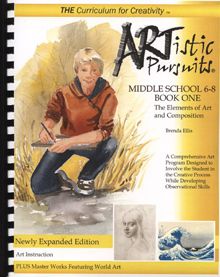
I was therefore thrilled, and a bit trepidatious, at the opportunity to review one of their brand-new, updated books. I received  Middle School 6-8 Book 1: The Elements of Art and Composition, available for $47.95 from their website, for the purpose of this review. It's a nice comb-bound book, so it lays open easily while we're working on lessons. It's directed at ages 11 and up.


The topics are organized into 16 units, and each unit has four lessons:
1. Building a Visual Vocabulary
2. Art Appreciation and Art History
3. Techniques
4. Application
Assignments are color-coded in gold, so it's easy to see exactly what they need to do. Students should plan to spend approximately an hour on each lesson. If they do two classes per week, the book will take 32 weeks to complete. The author notes that it is important to schedule art lessons when the student will have plenty of time to complete the assignment, even if it takes them more than an hour. That's a good reminder - it's hard to stop in the middle of a drawing and find your "groove" again when you come back to finish it.

The book is written in a lovely narrative style to the student, so my girls have been able to do the lessons without my direct supervision. I had initially hoped to be able to work through it along with them, but it didn't work out that way. They've been doing a great job on their own.

The supplies needed for this particular level are simple: drawing pencils and paper, pen & ink. We had many of required items and it wasn't difficult to find the rest. ARTistic Pursuits offers supply packs for each level, which are great if you're not sure what to buy or can't find what you need locally. It also makes it easy to get everything you need in once place so you're ready to start when your box arrives!

Because I have older editions of two of the books for younger ages, I contacted the author and asked if they were compatible with the newer editions. She responded quickly, and told me that the content is the same, with some added pages, so older and newer versions are compatible. Good to know!

I asked my girls what they liked most about the program, since they've been drawing away without me. My older daughter said she liked that the book was written to her (the student), and that there were specific instructions to follow. She and I are similar that way - we don't respond well when we're told to do "something." We like to know exactly what's expected. My younger daughter liked drawing household objects, and learning to look at things that are around us all the time from a different perspective. She also liked using several different drawing pencils in varying degrees of hardness in her pictures.

The first unit talks about space. One of the assignments was to draw a quick sketch from a painting, titled "Portrait if the Elephant, Dal Badal, Chasing His Attendant." They were to sketch the picture on a full sheet of paper, and then on a half sheet of paper. They both did the assignment, but my older girl lost her pictures. For some reason she didn't do them in her sketchbook, and they've wandered off. My younger daughter did a great job, though! Check it out!


Here are some of my younger daughter's other drawings:

Clockwise from top:
Illustration of the story of the 6 blind men and the elephant; our bamboo plant; daffodils; and her Bible verse memory cards on a ring

Here are some of my older daughter's drawings:

From left to right:
Her cat who hates everyone else; illustration of the 6 blind men and the elephant; daffodils

I've seen improvement in their drawing skills in the few weeks they've been using this book. The main thing is practice! With a book to follow and specific assignments to do, they spend time drawing regularly, incorporating new skills along the way. As they've worked through the lessons, they've seen they CAN draw, and their confidence has increased. My older girl would rather not bother with drawing most of the time, but she has enjoyed this book and I've been pleased with her work. My younger girl loves to draw, but is a perfectionist, and has a hard time believing in herself. I've seen her smile over projects she's created over the last few weeks.

Probably my favorite thing about the program is that it is teaching the girls to observe the world around them. In our Charlotte Mason homeschool, careful observation is key. Education is relational; all subjects are interconnected throughout Creation, and the only way to find those connections is to observe carefully. I love seeing how much more closely the girls observe things while they're drawing them.

I also love that art appreciation is included. We get to see pieces of art from famous painters as well as ones who are new to us, and each one is carefully selected to illustrate the topic for the unit. There is information about not only the artist, but the culture during the time the piece was created. We do have our own artist studies, but I appreciate the exposure to new works we haven't seen before.

I love this art book, and plan to have the girls continue working through it. I feel inspired to get out my kindergarten book for Isaac to use, too. ARTistic Pursuits offers art instruction for all ages: Pre-K, Early Elementary (K-3), Elementary (4th-5th grade), Middle School (6th-86th grade), and High School.  Don't forget those handy supply packs, which come with a bag to keep everything in one place. As a mom who wants to teach art but doesn't have any previous knowledge, I highly recommend this curriculum. I hope you'll check it out!

Click to read more reviews from the Schoolhouse Crew!


Saturday, March 09, 2013

Saturday Fun with Isaac

Todd's finally home after a week away, and we are all so glad to see him! He came home on the red-eye from California, so he's tired. Isaac has been waiting patiently for him to wake up from his nap on the couch. (He's snoring under all those pillows, couch cushions and blankets. You can see his toes if you look closely.)


I thought it might be time for Isaac and me to go outside. I managed to sprout two avocado pits, and they've been ready to put in the dirt for quite some time now. We've been meaning to plant them, but the job kept getting delayed. Today was the day!

The plants have been growing in glasses in the kitchen. Here is a link to the instructions I used. (I just went over them again, and learned that these are going to grow into trees. I thought they were going to be vines. Oops.) Half of each pit came off when I pulled out the toothpicks before planting them. I could see how the plant sprouted out of the seed - very cool!


First, we put some pieces of broken terra cotta pots in the bottom of our big pot. These serve to cover the holes enough to keep the dirt in, but let out any excess water. That's a handy trick I learned from my grandmother. Then, we filled the pot about 2/3 with potting soil, and arranged the little plants and their roots before covering them all the way. I hope they do well. They've been hanging out in only water for a long time, and sometimes water roots don't translate into dirt roots as well as I'd like.

I took the potted plants up to my bathroom, which gets lots of bright light and is practically a tropical environment in the summer time. If they get too big, I will have to separate them; I read that the trees can get from 20-40 feet tall! If they do grow into trees, I will have to keep them in the house in the winter, so I hope I can keep them smaller than that. Wouldn't it be fun to be able to grow avocados?


Isaac is wearing quite an odd expression in that picture. I tried to get him to smile by saying, "I love you, Mom!" That's what he gave me. Oh, well. 

After we finished with the plants, Isaac proceeded to make a giant mess on the driveway with potting soil and water. What better way could a small boy spend the morning? Then we took Charlie the Bucket Beagle on a walk, and everyone was happy. Hopefully Daddy got enough of a rest that he will be able to play with his boy this afternoon.

Note: A "bucket beagle" is out crazy dog, Charlie - he's the only one. :-) He's a hound-colored terrier mix. My sister calls him Charlie Bucket, and the nickname has evolved into calling him Charlie the Bucket Beagle. His full name is Charles Xavier Sarsaparilla.


Tuesday, March 05, 2013

REVIEW: "Abraham's Journey: A Celebration of the American Dream" Book


My girls have shown interest over the last couple of years in earning their own money. I confess that I haven't been as helpful to them in that as I could have been. For a while there, it seemed like they were always talking about garage sales. I feel stressed thinking about organizing a garage sale,  so we haven't done that. They've also wanted to try a lemonade stand, but we don't live in a neighborhood that gets much traffic at all, so I haven't encouraged that, either.

I was intrigued when I heard about Abraham's Journey: A Celebration of the American Dream, a book by Robert and Kathleen Basmadkian, from the company Inspiring the American Dream. I received a hard copy of the book, available from their website for $14.99, or as a Kindle book for 9.99. It's a nice paperback, with sturdy cover and pages, and nice illustrations. It's aimed at ages 7-12, and after reading it to my kids who are 5, 11, and 12, I agree with that. The girls understood it, but my little man didn't really, although he enjoyed hearing the story and looking at the pictures. 


The story begins with a boy named Abraham learning that his parents have lost their jobs. They tell him and his sister that they will still celebrate Christmas, but there will be no money for gifts. Abraham determines to do something about that, and starts using his smart phone to text his friends, looking for odd jobs and ways to earn money to help his family. While he's doing that, Abraham Lincoln appears in his screen, and proceeds to take him on a journey through a "cyber world," where he meets famous figures of past and present who exemplify the American Dream: Martin Luther King Jr., Norman Rockwell, Amelia Earhart, Mark Zuckerberg, Bill and Linda Gates. Abraham (the boy) discerns that his own special talent is painting, so he creates several paintings and proceeds to sell them, raising enough money to buy gifts for his family for Christmas as well as for donations to a local homeless shelter.


I confess that I had to go look up a definition of "American Dream," simply because while I've heard about it all my life, of course, if you'd asked me to describe it to you, I would have had a hard time.

In 1931, James Truslow Adams, an American writer and historian,  defined the American Dream this way: "...life should be better and richer and fuller for everyone, with opportunity for each according to ability or achievement." The United States Declaration of Independence state that "all men are created equal" and they are "endowed by their Creator with certain inalienable Rights," including "Life, Liberty and the pursuit of Happiness." I found this information on Wikipedia, and it did give me a clearer idea of what I was looking for from this story.

I enjoyed reading this book with my children. I liked that it talked about individuals finding their own special talent, and being creative in using it to find ways to earn money. I also appreciated seeing a young man acting selflessly to help his family in a time of need, and also finding a way to help other people, as well. I appreciated, too, that it mentioned the Great Recession, a part of history we are all experiencing now. It prompted a great discussion with my girls. Had I been paying a bit more attention, I would have noticed brief biographies of the people mentioned in the book, and we would have read those first. The story makes more sense when you know a little bit about the people mentioned. There is also a list of vocabulary words and their definitions - very helpful! I do feel that the story gave us a lot to think about, and I intend to continue talking with them about what they believe their own special talents to be and how they might use them to accomplish their own goals as well as bless others.

While the story is clearly written as a fantasy or dream, I like to see a more realistic picture of the effort it takes to make enough paintings to sell, and how Abraham came up with the money for the supplies to create them. The American Dream is all about creating your own success with your own hard work, and my one criticism of this book is that it skated over the hard work portion of the process.

Overall, we enjoyed reading this book. It's a great idea, and a good way to present the ideals of the American Dream in a narrative, living way. I hope you'll check it out!

Click to read more reviews from the Schoolhouse Crew!

Disclaimer: I received a free copy of this product through the Schoolhouse Review Crew in exchange for my honest review. I was not required to write a positive review nor was I compensated in any other way. All opinions I have expressed are my own or those of my family. I am disclosing this in accordance with FTC regulations.

Thursday, February 28, 2013

Thankful


 It's been a bit of a rough week at my house. My 5 year old is challenging me at every turn, trying to see who's really in charge. (Hint: It's not him, despite his best efforts.) My younger two are bickering incessantly, it seems. My husband will be out of town all next week, which means things never run quite as smoothly. I'm not looking forward to that at all, particularly in light of the current attitudes among the short people.

And yet, I'm reminded to be grateful for every moment, even the ones that are less fun. A mother lost her son to cancer yesterday. A friend's 11 year old daughter is recovering from a stroke. Another friend's twin sister is recovering from a heart attack. My heart breaks for each of them, and as I lift them each in prayer, God reminds me how very blessed I am.

As I type, I'm watching all three of my children as they color pictures together while laying on the floor in my living room. They're not sitting in school, away from me, staring at a chalk board. My crazy dog is snuggled up with me on the couch, and I can hear my cat snoring. Even on the worst days, I love this life. I love these people God has loaned me.

I don't have any profound words to share. I just wanted to profess my thanks for the many, many wonderful things in my life - the things that God brings to my attention, as well as the things I take for granted every day. As my friend Dy says, "Kiss those babies!" I want to remember to appreciate every single moment with these beautiful bits of creation, because I cannot know what will happen tomorrow, or even 5 minutes from now.

Be joyful always; pray continually; give thanks in all circumstances, for this is God’s will for you in Christ Jesus.
I Thessalonians 5:16-18

Wednesday, February 27, 2013

REVIEW - College Common Sense


I have a confession to make: I try to pretend that my children aren't growing up. I *like* having them around. I don't want to be one of those women who is at a loss when their children are grown and gone, but I wonder sometimes if I'm headed in that direction. I get a little panicky when I think about it, so I try not to do that. :-) In the last few months, though, I have heard the Holy Spirit starting to speak in that still, small voice. He's bringing things like College Common Sense to my attention, reminding me that pretending my children will never grow up will not make it so, encouraging me to get my head out of the sand and focus on important things.


When the opportunity came up to review the Going to College and Paying for it Online Video and Workbook, I didn't really want to take it. I'd prefer to believe I don't have to worry about college for my children just yet. The reality is, though, that my oldest will be in 8th grade next year, so it would be a good idea to start thinking about it and gathering information. 

Denise Ames is the author and creator of this program, and she comes with several years' experience in a university financial aid office. Her goal is to educate students and their parents about the financial aid process, choosing the right college, and ways to finance a college education beyond federal financial aid. She offers a free monthly newsletter, as well as free lesson plans via email, full of great information and ideas. The lessons are broken down into activities for parents, seniors in high school planning to attend college in the upcoming fall, high school students, middle school students, and elementary students. Additionally, you can purchase her Going to College and Paying for it workbook and DVD for $50, or sign up for 12 months' access to the online workbook and videos for $25. For the purpose of this review, I was given access to the online video and workbook. The program can work for all ages, but I think junior high and high school students will get the most benefit from it. It would most certainly be best to start before your senior year in high school!

First, I printed off the workbook files for myself, so I had a copy in front of me. Then, I proceeded to work my way through the videos. I felt a bit overwhelmed at first - there is a LOT of information to process! However, she presents it all clearly and sequentially, giving specific steps to follow, which helped me feel much more knowledgeable and confident. Then, I had the girls create notebooks as she directed, proceeded to work through the activities she gave us in the weekly lesson plans. 

For example, in Week 1, she told us about the Free Application for Federal Student Aid (FAFSA) website, where if you are a high school senior, you should get a PIN number (both the student and the parents do this), and fill out the application for federal financial aid online. We didn't do this yet, but there is also a link to the "FAFSA4caster," which allows anyone to put in their current information and see what their expected family contribution, or EFC, would be if they were applying for college in the fall. It's great information to have, because even though the numbers could change over the next few years, at least you have a starting point for planning.

Another great suggestion was to have my kids practice taking a timed test. There are tricks to them, and it's a good time to get them familiar with how they work. As homeschooled students, they don't really have timed tests. I did give my girls a timed math test, and it brought forth much weeping, wailing, and gnashing of teeth. Apparently we need to do them more often, which will require much exercise in patience for me.

She describes lots of ways to go about gathering information for each child, and says it's never too early to start - she's seen a scholarship given to a child as young as 6! Even if college is a few years (or many years) away, there is something you can do to increase your knowledge about what your child wants to do and how to get them there.

One great idea is the "All About Me" notebook. Your student takes a spiral notebook, nothing fancy, and uses it to write down things they like to do, things they don't like to do, volunteer experience, etc. It's a place to collect their thoughts about their interests, dreams, and goals to help them figure out what kinds of scholarships might be a good fit and which college might be best for them. This caused a great deal of stress for my girls, who seemed to be intimidated by it. I believe it will be an invaluable tool for them once they are used to the idea, and I'm glad we started it now. It will be interesting to see how they refine their interests and goals over the next few years.

When I applied for college, I was clueless. I was the oldest in my family, so no one had been through the process before. I knew nothing about scholarships or financial aid, and depended solely on what came through my university's financial aid office. I found that my family's income was enough money that I didn't qualify for much aid, but not enough that we could just fork over the cash, so I ended up with a lot of debt. I've watched the cost of attending college skyrocket over the years, and know that it is more important than ever to plan ahead as much as possible. College Common Sense offers an excellent way to start the path to college - reminding all of us that it begins MUCH earlier than January of senior year in high school! I hope you will check out the website and DVD/workbook. It's an invaluable resource.

Click to read more reviews from the Schoolhouse Crew!


Thursday, February 21, 2013

REVIEW: Wet, Dry, Try App for Handwriting Without Tears


I live in a family that loves technology. Since my husband is a computer guy, we have a lot of nifty tech devices. As is often the case, my children know how to use these things so much better than I do! My five year old, in particular, thinks it's big fun when he's allowed to use "his" iPad. 

We've been trying to do some school work with him this year, but he's been resistant - particularly when it comes to handwriting. Does he sound like a typical boy, or what? 

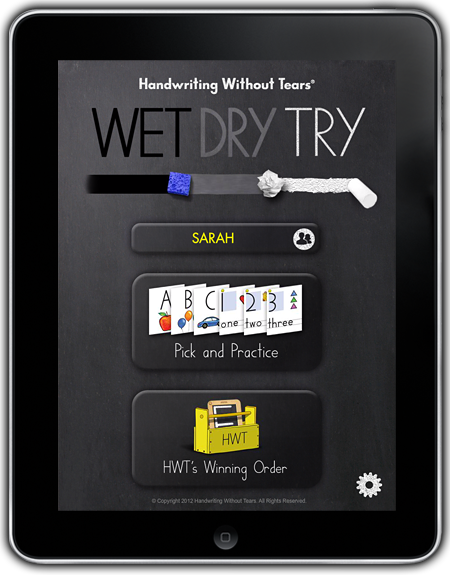
Enter the Wet- Dry-Try app, from the creators of Handwriting Without Tears handwriting curriculum! For the purpose of this review, I received a download code for the app for the iTunes store, regularly $4.99. It works with all versions of the iPad, even our old "first generation" one. The app is also available for Android devices from Google Play. It's aimed at Pre-K and kindergarten aged children, and could also be used with older children for remediation. 

There are two choices for how you'd like to use the app: "Pick and Practice," which allows you to choose whichever letter you'd like, and "HWT's Winning Order," following the order in the Handwriting Without Tears curriculum. There are three levels of difficulty for each letter. Once the student achieves 3 stars for a letter, they earn a "letter card." Children seem to like to collect cards, don't they? I know Isaac does!


Isaac had a LOT of fun with this. We used the "Pick and Practice option." I had him do the letter of the week from our K curriculum first, and then allowed him to try any other letters he wished. The app mimics the Handwriting Without Tears chalkboard activity, in which the student has a small chalkboard, a wet sponge, a paper towel, and a piece of chalk. First, the "personal instructor" (or, as I like to think of the voice, the Invisible Person) inside the app demonstrates how to form the letter correctly by writing it with the chalk on the virtual chalkboard. Then, the student uses their finger to make the letter shape with the wet sponge icon, then with the paper towel icon, and finally writes it themselves with the chalk icon. In the app, you trace with your finger each time, and the screen shows the sponge, the paper towel and the chalk on each successive turn. Once the student completes the letter successfully three times (wet, dry & try), they get a star, which Isaac thought was pretty cool. He also had me try, and was ever so proud when I achieved a star for my letter-making. :-)


When he first started using the program, I thought it might be a little too sensitive to error. I watched him try to make a capital "B," for example, several times, unsuccessfully. However, he did learn to pay closer attention and be more careful, and eventually he got it right. It was good for him to have to work at it a bit. I read in the FAQ section on the website that "After testing, [they] landed on the degree of sensitivity that is most helpful in preparing children to write well." Look at that! They agreed with me. Oh, wait. Maybe that should be the other way around . . .

I like that the personal instructor encourages the student. If they make an error, it says something like, "Let's give that another try." When you get it right, it says something like, "Great!" or "Cool beans!"  It might sound a little silly to me, but Isaac responds well to the encouragement. Sometimes, Isaac's teacher forgets to be encouraging and might indulge in more frustrated sighing than is strictly necessary. Ahem. The Invisible Person In The App is very nice, all the time. Her voice is pleasant to hear, also. That's important. Isaac talks all. the. time. I don't know if I could listen to him chattering and handle a grating voice coming from an invisible person.

This is a great app. Isaac enjoys it, and it teaches correct letter formation, which he needs to practice. He can't practice reversals or starting his letters in the wrong place with this app, like he can with pencil and paper. He argues far less with the Invisible Person than he does with me, and he doesn't seem to get frustrated at having to start over. I also love that he gets the practice of the chalkboard activity without using an actual chalkboard. Chalk is so messy, and as we do a lot of school on the couch, I much prefer the iPad option.

I've been considering cutting back on "school" with Isaac to math and handwriting, and after using this app, Handwriting Without Tears is one of my top handwriting choices. Even if I don't end up purchasing the curriculum, the app is great for painless handwriting practice.

Click to read more reviews from the Schoolhouse Review Crew!


Monday, February 11, 2013

(re)Learning Hard Lessons

The last two weeks have been a little rough at our house. Around Christmas, we learned that one of our cats, Twink, was in the beginning stages of kidney failure. He'd been losing weight for over a year, but this was the first time anything showed up during his annual exam to indicate a problem. Our vet had him start taking a probiotic, which seemed to be helping, so I decided to pretend that he would be fine and thought very little about it. About two weeks ago, I noticed that his lips and nose were white instead of pink, which is never a good sign. I took him back to the doctor, and he said that his numbers (which indicate the level of bad stuff in his blood) had gone up quite a bit, and had me leave him there for IV fluids for 3 days. He felt better after that, but within two days, his symptoms had returned - he was pale again, and his breath smelled like urine (that had been going on for a long time, I just didn't know what it meant - that his kidneys were not filtering waste out of his blood, so I could smell it on his breath).

I decided to ask our vet from Raleigh for a second opinion, and she encouraged me to ask for an ultrasound of his kidneys. We had that done Friday, and the results were not good. Without going into gory detail, he's reached the end stages of his illness. After discussing it briefly with our old veterinarian, she agreed that he would likely not survive the surgery and we should make quality of life decisions for him now. We know his remaining time with us will be short.

It's hard to have the kids at home with me right now. In many ways, I would prefer to shield them from seeing me cry and having to talk to different people about what we're going to do about this cat we all love so much. However, I think they've learned some good things from all of this.

They have learned that having a pet is a huge responsibility, and at some point, it is a painful one. We've all had a hard time watching this loving, active cat decline until he's hiding away in a corner, just trying to get through each day.

They've seen me be an advocate for my pet's health, asking for more information than my current vet was offering, challenging some of his assumptions when they didn't sit well with me. I'm glad I did; he's much worse off than we'd thought, and without the ultrasound, we'd still be trying to figure out what was going on, probably trying to treat him with things that wouldn't help and would only cause him more distress.

They know that it is okay to grieve, and in fact, that it is important to do so. My girls are being very sweet to me, because they know this is my special pet who's dying. I cry a lot; I can't help it. Sometimes they hug me, and sometimes they cry with me. We're not pretending everything is fine. I'm finding it difficult to get on with our regular things, like school, so we're taking it easy today.

They are learning to be grateful for the gift of this little animal, this tiny piece of God's creation, one of His many gifts to us, even though our time with him has been cut short. I want them to remember to be grateful in all things. It's hard, today, to feel grateful, but we remind ourselves that we do give thanks for the love and laughter we've shared thanks to this sweet boy.

My public service information for pet owners:

1. If you pet starts losing weight, and there have been no changes in diet or activity level, something is wrong. Don't listen to your vet if they want to appreciate the weight loss in a formerly plump pet. Ask them to figure it out.

2. Once any animal (or person's) kidneys are bad enough that numbers show up in blood work, their kidneys are already functioning at less than 25%. I did not know that. I thought it was an important piece of information. The time left was so much shorter than I thought.

3. If your pet's head smells like urine, it means their kidneys are not filtering the toxins from their blood properly. Time to go to the vet. Twink's head smelled like urine for a long time and I didn't know why. It didn't occur to me until far too late that I should ask the vet.

That's all I can think of for now. As my friend Dy says, kiss those babies, and I will add, hug those pets.

Sunday, February 10, 2013

REVIEW: Apologia Anatomy & Physiology


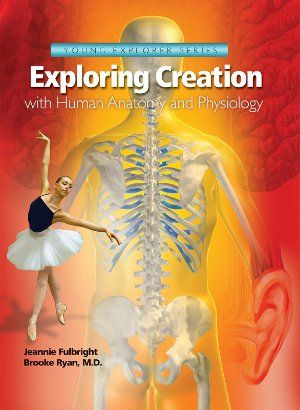
When the chance to review Apologia Educational MinistriesExploring Creation with Human Anatomy and Physiology curriculum arose, I was intrigued. We haven't used any of their books before, but I have heard many good things about them from homeschooling friends. We use Charlotte Mason's principles in our homeschool, and I had heard that the Apologia books would work well with the approach while providing the structure of a textbook.

Apologia's textbooks are quite different from anything I ever read in school, and are written to the student in a narrative style, rather than simply presenting facts. The books are written with Charlotte Mason's philosophy in mind, incorporating narration and notebooking activities. The Young Explorer series, directed at elementary students, follows the days of creation in its topics: astronomy, botany, flying creatures, swimming creatures, land animals, and finally, human beings. Apologia is a Christian company, with lots of resources available in addition to their science products.

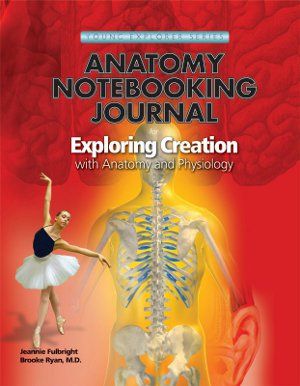
The publisher offers the following items with this curriculum: the  Human Anatomy & Physiology textbook, $39.00; Anatomy Notebooking Journal, 4-6,  Anatomy Junior Notebooking Journal, K-3, $24.00; and the Human Anatomy & Physiology MP3 Audio CD,  $29.00.  There is an optional Blood Typing Kit, good for one student, available for $14.00.


For the purpose of this review, I received a copy of the Human Anatomy and Physiology textbook, regular Anatomy Notebooking Journal, and MP3 audio CD. I did purchase an extra Notebooking Journal so my girls would each have one. The Young Explorers series is generally for children in grades K-6, but Apologia does recommend Anatomy & Physiology for upper elementary students, 4th-6th.

The textbook is a nice hardcover, which I love. There are 14 lessons, and they are designed to be done over two weeks each. The topics covered are:


1. Introduction to Anatomy and Physiology
2. The Skeletal System
3. The Muscular System
4. The Digestive and Renal Systems
5. Health and Nutrition
6. The Respiratory System
7.  Life in the Blood
8.  The Cardiovascular System
9.  The Nervous and Endocrine Systems
10. The Nervous System Extended
11. Your Senses
12. The Integumentary System
13. The Lymphatic and Immune Systems
14. Growth and Development


The notebooking journals come spiral-bound, which works well for writing and drawing in them. They also contain the schedule, directing them to narrate what they read, which makes sure we discuss their readings. The schedule also has all activities clearly listed, so you know if there is an experiment to do, etc. There are lots of fun activities: drawing, crossword puzzles, mini-books (like you'd use in a lap book, but they go in the journal) and - EXPERIMENTS! See below to check out some of the fun we had.

Because the CD contains an MP3 audio book, you need an MP3-compatible CD player, or you can play it in your computer. For a PC, there is an auto-run program. On a Mac, you double-click on the CD icon and then double-click on the MP3 file you'd like to hear. I love having an audio book to go along with the text. One of my girls gets headaches from reading (we're working on finding a solution for that), so having the option available for her to listen to her assigned pages is wonderful.

We enjoyed doing the projects together. First, we learned how to mummify an apple, to show us what happens when you mummify an organ. We made a mixture of salt and baking soda, and put one peeled apple into that, and left the other one open to the air. We looked at them a week later, and see what happened? The smaller, darker one on the left is the mummified apple, and the one on the right is our control apple.


Then, we learned about cells, and all those nifty organelles that live and work inside them. This time we got to make our own model cells with Jell-O and candy.  It was a good time to review the function of each organelle, and remind us what they looked like as we compared them to the candy we used to represent them in the Jell-O.


The best part was, once they were finished, they got to each all that delicious (?) candy and Jell-O. I believe that was Isaac's favorite part. 

My girls, who are 11 and 12, have learned a lot during our time with this curriculum. Apologia's book is well done for its intended age group of older elementary, 4th-6th grade. It's written to the student, so they have the schedule and can read on their own. I would love to be able to read everything with them snuggled up on the couch with me, but with a very busy 5-year-old boy in the mix, that doesn't happen as much as I'd like. I was able to utilize the CD to keep up with what they were reading. I found the notebooking journal to be a valuable addition, because it keeps all their work in one place. We've had some difficulty keeping track of our studies in binders during previous studies. I've been able to have the girls read on their own, narrate to me, and then have us all meet at the table or in the kitchen for the activities, since Isaac enjoys being a part of those as well. 

If you're looking for a gentle, easy-to-follow science curriculum, I recommend taking a look at Apologia. I will be looking at some of the earlier books for use with Isaac, when we start more formal school with him next year.


Friday, February 08, 2013

The Eyes Have It!

The kids and I went to the eye doctor this week. Usually, this is not a significant event in our lives, but this time there were several surprises.

Isaac, who is 5, needs glasses. Apparently, he has quite an astigmatism in one eye. This could explain why school has been such a struggle this year. Thinking back, he does try to write with his face up close to the paper, like I do when I am not wearing my glasses, but it wasn't until the day before our appointment that I had an inkling of his near-sightedness. He was thrilled to choose his frames, and almost immediately identified a bright blue pair. Of course, he had to try on as many kid frames as he could reach, he didn't break anything, and it did serve to keep him occupied while we completed the order. I feel a little guilty for not noticing that he couldn't see. I feel I should have expected it, given our family eye history. The very nice young woman who fitted our glasses told me that children often don't know they can't well, because they don't know any differently. I am sure she's right, but I still wish I'd been paying more attention. It also makes me more than a little sad to put those big beautiful eyes behind glasses, but I'm thrilled that he will be able to see better now. These are supposed to be "boy-proof" frames. He's not the first little boy to wear glasses, to I'm sure manufacturers know how to make them so they last longer than 5 minutes. We will see!


The girls had appointments together on another day. Abbie has worn glasses for 3 years, and Emma has never needed them. According to the eye doctor, Abbie should NOT need glasses at all, and Emma does! He was pretty confused to see Abbie with glasses on.

Abbie was quite distraught when she was told she didn't really need her glasses. She gets a lot of headaches, and she says her glasses help. Also, she doesn't want to "look different," she told me. I think she has a fair amount of her identity wrapped up in wearing glasses. Most kids would be delighted not to need them, but not my girl. We did get her a new pair, since she's grown quite a bit since she got her old ones, and they look pretty rough. The optometrist also recommended a pair of very low strength reading glasses, +.25. He thought they might help with her headaches, since they often come on when she's reading. Those are not easy to find, and I may have to order them online. If you've seen some, please let me know where!

Emma, who does need glasses, insists that she doesn't want any. She said it will be too much responsibility and she's sure she will lose them. The doctor said she doesn't need them badly enough to insist she wear them, but she should prepare herself, because she will need them in a year or two, almost certainly by the time she starts driving. I'm going to pretend he didn't say that. I'm fine with glasses, but I refuse to think about her driving yet. God is really challenging my place in the land of denial lately!

Why is this worth blogging about? I don't know. Lots of unexpected things happened at our house this week, so perhaps this is a bigger deal than it would otherwise have been. My children certainly keep me on my toes and make life interesting!