Pages

Sunday, April 14, 2013

REVIEW - Supercharged Science


Have you ever heard of Supercharged Science? I have heard a great deal about this company over the last few years, and have been itching to try their e-Science program. Aurora Lipper, author of the program, has a Master's degree in mechanical engineering, taught as an instructor at Cal Poly State University and worked at NASA on rockets and jets. She is a ROCKET SCIENTIST - for real! She was struck by how bored students were with science, and couldn't understand it - until she learned how most of us are taught about science in school. She set about creating her own lesson plans for science, and after teaching her first lesson to a group of local elementary students with great success, she went on to have a science camp. All this gradually evolved into Supercharged Science - a program that is fun for children and easy for adults to implement.


Aurora's approach is to teach science "from the inside out" - let children do some experiments, see how cool the results are, and then teach what's behind it all once they are hooked and excited to learn more. You don't just throw supplies at them and let them have at it, either. She encourages students to keep a science notebook, and carefully record what they do along with their results. She teaches them how to work with the scientific method and do things correctly. Here is a list of topics covered in the program:

Scientific Method Energy Light Thermodynamics Earth Science
Mechanics Sound Electricity Electronics Science Fair Projects
Motion Astrophysics Magnetism Life Science Mathemagic
Matter Chemistry Alternative Energy Biology


Would you like to see some of the things we did? I knew you would! Let's take a look, shall we?

We started out with the Scientific Method unit, because we've done very little formal science and I don't believe we've ever discussed it. The first thing they did was see how many drops of water would stay on top of a penny before it all splooshed out. Using an eye dropper, they counted the drops as they went along. It was interesting to note that Emma got quite a few more drops to stay on her penny than Abbie did.


After that, we decided to start with Unit 1, Mechanics: Force, Gravity and Friction. We had most of the supplies around the house, so it was a good place to begin. First, we read together the unit overview, vocabulary words, and text, and then I had them do some experiments. First, we looked at magnetism.

I decided that we would look at eletromagnetism using a balloon and a cat. Aurora didn't tell us to do this experiment, I promise, but it was a great deal of fun and we laughed a LOT. (No cats were injured while a balloon was stuck to them.)


Then, we went outside with a compass. I have never used a compass, and wouldn't know how to get myself anywhere with one, but they work because the magnet inside can detect the earth's magnetic field, and it makes the needle in the compass always point to the north. (The experiment was to show us that the earth *has* a magnetic field, not to understand exactly how a compass works.)


We also looked at magnetism in o-shaped cereal. It turns out that if you put some of the cereal in a bowl and stir them around so they have to move away from each other, they attract back together into a group.

Next, we took a look at gravity. This was highly entertaining for me. First, I had the girls jump into the air to see if they would come back down. Guess what? They DID! I had them repeat this a few times to make sure our hypothesis was sound. Then, we tried it with a rubber ball, and learned that, indeed, gravity still worked.

Gravity works! :-)
We moved on to find out whether an object thrown horizontally will fall at the same rate as one that is dropped (it does, much to my surprise), and then did another experiment to see if weight figured into the equation (it doesn't seem to - opposite of what I thought). These were all simple, but we had FUN while we were doing them, and they had to think about what was happening and why. After we did the experiments, we completed the corresponding exercises in their science journals.

The way the program works is this: you sign up for a monthly subscription, which costs $37 per month for grades K-8, or $57 per month for grades 9-12. For the first month, you are given access to the first seven units: Mechanics, Motion, Matter, Energy 1, Energy 2, Sound, and Astrophysics. Each month after that, you will receive access to two more units, in the order given on the website. If you see something else you want to try sooner, you can email them directly and they will give you access. Also, they have conversion charts available that show you how you can use the program in conjunction with several popular homeschool science programs. As you consider signing up for the e-Science program, be sure to read their terms of service (as you would for any other subscription program). They do have a 30-day satisfaction guarantee. If you'd like to try it out before you subscribe, you can sign up for some great free stuff and try it out.

There is a TON of information on this website. It feels a little overwhelming at first, actually. However, once I took a deep breath and started really looking at what was available, I was impressed. I like that there is so much hands-on learning to engage a child. Even the "textbook reading" is very well done - it's written in a conversational tone to the student. Aurora Lipper is passionate about science, and it shows in all aspects of the program. She is also available to answer any questions you may have.

The girls and I *loved* using this program. It really is accessible for all ages. There was a lot that Isaac could do and understand along with us. They appreciated the hands-on learning and looked forward to doing science. This program is a great example of living science and worth considering for your homeschool.

 Click here to read more reviews from the Schoolhouse Review Crew!
REVIEW - Timeline Builder App from Knowledge Quest


I have been a fan of Knowledge Quest products for years now. I'm pretty sure I own most of them! 


I already owned the Timeline Builder iPad app when the opportunity came up to review it. It was a great opportunity to finally put it on the girls' iPads and see how it worked.

I love the idea of timelines. I have attempted to do timeline books with the girls. I've printed my own, and I've used bound books (the ones from Knowledge Quest, incidentally, are lovely). However, it's just not something we remember to do regularly. It can be time consuming to look up the images and make sure they're all ready to go in the book. Also, I'm a bit of a perfectionist, and my girls have inherited that trait, the poor dears. We actually bought a book with suggestions of where to put the figures in our timelines, because we were so concerned about messing them up. (It was good to know, actually, that there is enough demand for someone to create that resource. We're not the only ones! Ha!)

The TimelineBuilder iPad app makes the entire process SO much simpler! Here's how it works:
  1. Open the app, and click on the "New Timeline" tab at the bottom of the screen (it's yellow).
  2. Give your timeline a name by tapping in the "Timeline Name" field, add a description if you like, and enter the starting and ending years. You have the option to choose BC/AD or BCE/CE, whichever appeals to you.
  3. Select a background for your timeline by tapping on the "Select Background" button. 
  4. Voila! You have a lovely blank timeline! In the upper left corner, you will see a button that says "New Event." Click on that. Tap in the fields to bring up the keyboard so you can enter the information. 
Creating the Timeline


See there? That's all there is to it! Once your events are entered, you can use your finger to tap and drag your pictures where you'd like them to appear on the timeline.

I started out by making my own timeline. I thought I'd just go from the beginning of history until present day. That may have been overly ambitious, so I revised my plan. I decided to start out more simply and make a little timeline for my son. First, I created the timeline. I added his birthday, when he started preschool, his broken leg with a graphic from the internet, and picture of him digging for treasure in our yard, with a picture my daughter took with my iPad.

When you want to add an image to the timeline from the internet, the app automatically takes you to Wikipedia, but you can go from there to anywhere else. The timeline app will close when you do this, because of the way the iPad works. Once you've found the image you want to use, the key is to keep tapping it until it's the only thing you see, and then hold your finger on it until the "copy" menu comes up. Then, you will exit out of the web browser, go back into the app, and select "Import from Pasteboard." Choose the pixel size of your image, and then you will see it in your timeline record. It took me a little playing around to figure out the "Import from Pasteboard" button.
Adding a graphic from the internet
Adding a picture from the camera roll on the iPad is quick and simple. First, click on the button that says "Import Image from Library" It brings up the little screen you see below on the left, with the photos  you have available. Tap on the one you want, and it will take you to the resizing screen (above left). Once you choose your size, your picture is there and your event is ready to go!

Adding a picture from the Camera Roll on my iPad
When I was ready to have the girls create timelines of their own, we decided to make one to go along with a book we're reading,  Our Island Story by H.E. Marshall. We've been reading it over the last couple of years, and they've enjoyed it. It's been one of our favorites. Conveniently, the version of the book we have includes timeline dates. They add images when we can find them, but it's not required. It's an ongoing project, and we're all having a good time with it. They love to be able to work independently of me and not having to do lots of cutting and pasting of paper. I would still like to do a hard copy timeline book, but perhaps we will make it a family project instead of everyone doing their own. My plan going forward is to have them create a timeline for each year in our history cycle.

The only very small detail I didn't care for in the app was the way the images are sized. They automatically become square, so they are a bit distorted. You really don't notice it much when you look at your timeline, but if I had my "druthers," I would be able to choose the portion of my image that would fit in the required spot in the app, and be able to maintain the original proportions.

When I first got the app, the application that came to my mind was to use it as a tool for our history studies. It has proved to be excellent for that purpose - but you can do so much more with it! You could use it for many subjects, including science and literature, as well. I love the idea of making a family timeline. I love genealogy and thought it might be fun to make a timeline of my grandmother's life. I'd like the girls to consider doing one for their own lives. It has business applications, as well. You can even share your timeline via email or with other users of TimelineBuilder.

The app is intended for all ages. I would think any child who could read could use it easily. I am sure my 5-year-old (not reading quite yet), could use it as well, but I would have to do the data entry for him. It's available for the Early Bird Special price of $4.99 (reg. $6.99) on the iTunes App Store. Definitely check it out! They have lots of images with ideas on their website.

Click here to read more reviews from the Schoolhouse Review Crew!


Thursday, April 11, 2013

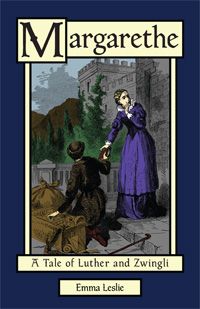
REVIEW: Margarethe from Salem Ridge Press


It's no secret that I love living books. I love them so much, I'm working on starting a library so other people can enjoy them with me. I've heard good things about Salem Ridge Press and the books they publish, and was delighted to receive Margarethe to read and review with my girls.


Salem Ridge Press was established in 2005, with the mission to reprint quality children's books from the 1800's and 1900's. I've heard a lot about their books from homeschool librarians, and have wanted to read one. When our copy of Margarethe arrived in the mail, I started looking it over in preparation for reading with the girls, but quickly absconded with it and spent the weekend reading the entire thing before beginning it with them. Our book is a nicely bound paperback, and is also available in hardcover. The font is a nice size for easy reading (this has become more important to me now that my eyes are, ahem, getting older), and there are words, possibly unfamiliar to the reader, defined at the bottoms of the pages. This is a great feature - I present vocabulary to the girls at the beginning of any reading, and this made it easy to do that. The book also includes historical notes, a timeline of important dates, and a map of 16th-century Germany. The story was written over 100 years ago, so the language is a little different than what we read today, but we had no difficulty with it.

This is a wonderful story, set in Germany and Switzerland in the early 1500's,  at the time when Luther and Zwingli were preaching the Gospel and speaking out against some of the practices of the Church at that time. The main character is, of course, Margarethe, a strong-willed German girl, daughter of a knight, who has decided she hates religion and will no longer participate in the sacraments of the Church. Her sister, Else, is sent to live in a convent, leaving Margarethe essentially alone in her father's lonely castle. Through a pamphlet her brother brings to her, written by Martin Luther, she learns the truth about God - the he loves her! She teaches the Truth to the people in the village near her castle, and goes on to spread the Word to others, even at the expense of her relationship with her father.

Here are some things that stood out to us from the book:
  • My husband was raised in the Lutheran church, so it was fascinating to read about Luther and how the Reformation began.
  • My family and I have recently started attending a local Moravian church. The brochure we received from them states that they have Protestant roots that predate Luther, and this book mentions John Huss, who preached 100 years before Luther; he sowed the seeds for what would eventually become the Moravian Brethren. Reading the little bit about him in the story inspired me to learn more.
  • My oldest daughter has been struggling with her faith. I loved that she heard about another girl of a similar age who struggled with the same thing and came to know the truth about God. I hope it will inspire her to seek to know Him more closely for herself.
  • We learned what a precious gift it is, to be able to read the Bible in our native language. Margarethe longed for a German Bible; at that time, the only thing available was the Latin Vulgate and the Church discouraged "regular" people from reading it. We've known some missionaries who work to translate the Bible into other languages for people, and this story illustrated very well why it's so important.
The author of the book, Emma Leslie, was an English author who lived from from 1837-1909, and wrote over 100 books for children. Margarethe is one book in her Church History series, a set of historical fiction books, intended for children ages 12 and up. To date, Salem Ridge Press has republished the first 12 books, which span from the time of Paul to the beginnings of the Reformation, and they hope to publish the remaining 12 titles, which will cover from the time of the Reformation through the Methodist revivals in the 1800's. They are written from a reformed perspective, meaning that the characters rely on the Bible rather than the traditions of men.

If this book is any example, I would love to read them all! I plan to look at more titles to see how they correlate with our history studies, and hope to incorporate them. If you would like to read more about the books Salem Ridge Press has to offer, check out their Complete Listing page. You will find the books listed alphabetically by title and author, as well as by time period and by recommended age range. These are lovely books and I hope you will take a little time to find out more about them.

Margarethe - $14.95 paperback, $24.95 hardcover

Click to read more reviews from the Schoolhouse Review Crew!


Wednesday, April 10, 2013

REVIEW: ABeCeDarian Reading Program


My little man is 3rd in line in our homeschool to learn to read, and I haven't been sure how to approach it with him. He knows all his letter sounds, but when we've tried word building, he hasn't been interested. It's been hard to tell if he's just messing with me (reading "CAT" as "FROG") or if he really doesn't understand how to read the letters in sequence. I'm pretty sure he just doesn't want to take the time to read them. He's so silly.

I was excited to try the ABeCeDarian Reading Program from ABeCeDarian Company! The ABeCeDarian program has four levels:
  • Level A - students reading at kindergarten through mid-1st grade level
  • Level B - students reading at mid-1st grade through 2nd grade level
  • Level C - students reading at 3rd and 4th grade level
  • Level D - students reading at 5th and 6th grade level
  • There is also Level A (Short Version) for older students (8 and up) who are non-readers or just beginning to read.
The pictures say 2006, but the program has been updated in 2013.
They have a handy placement test to see where your child needs to begin. The company has recently issued a combined-volume book containing levels A1, A2 and B1 for homeschoolers and tutors, which includes all student pages as well as the teacher's manuals. For our review, though, we received individual teacher and student books for levels A1, A2, and B1, as well as the Set of 10 Storybooks and the ABeCeDarian Aesop booklet. The teacher's books and student books are nicely coil-bound, so they lay flat on the table (less important for the teacher's manual, but definitely helpful for the student when they need to write). The pages in the student book are simple and uncluttered. The storybooks and Aesop booklet are half-sheet sized books with paper covers. The pictures are black and white, but cheerful. I like them MUCH better than some of the readers I've used in the past.

The Teacher's Manual includes excellent information, explaining the philosophy of the program as well as how to use it. It explains what a child needs to be able to decode well, as well as why some children have a hard time learning to decode. The lessons are scripted, so I knew exactly what to say for each step. I wasn't sure I would like that, but it worked well and seemed natural. I don't think Isaac noticed I was reading instead of just talking with him. There is also a section on teaching handwriting, and the directions for forming letters are little sayings like "Curl back like a rainbow. Swing around." for the letter "c". Isaac had been rather resistant to handwriting, but he liked the sayings and would repeat them as he wrote. It seemed less like me telling him what to do, I think. I did write the letters using a highlighter for him most of the time in the beginning, but now he's more comfortable writing them on his own.

There is also excellent instruction on how to correct errors. For example, if Isaac were to read /o/ as /a/, I would simply say, "This is /o/. You say /o/." It's a non-confrontational approach, and since Isaac and I both lead toward the confrontational side, it helped keep the lessons focused on what we were learning rather than Isaac feeling as though I was telling him he was doing things wrong.

Since he's just beginning to read, we used Level A1. This level begins with single consonants and short vowels in simple CVC words,. Letters are referred to by sound rather than by name. Once he's mastered those, he will learn the two-letter combinations sh, ch, th, and ck. He will also learn the sight words the, as, is, of, to, and I in this level.

The first activity was Word Puzzles. This was so much fun! ABeCeDarian has free letter tiles you can download, print and cut out, but my printer is acting strangely, so we used some we already had. I told him we needed to spell a word, but the letters were all mixed up, and it was his job to put them in the correct order. He loved doing that. He was my little detective, solving the word mystery. We practiced writing individual letters while saying the sounds, and writing words while reading them. I would say a letter sound and he'd point to the letter; I would point to a letter and he would say the sound; I dictated sounds and he wrote them.

Once we'd built all the words and practiced writing them, we did "Tap-and-Say." Isaac tapped each letter on the page, saying the sound as he did so, then ran his finger under the entire word as he read it. Then, I would read the words in "Turtle Talk," sounding them out slowly, and his job was to translate them into "People Talk," reading them normally. I loved this and found it to be marvelously effective. He loved it, too, because I sounded silly reading in "Turtle Talk" and he got to correct me with "People Talk." There are also free word cards you can download and print for extra practice (see this page for their supplemental materials).

I've read a lot about phonics and reading programs, and one thing I wondered about was combining handwriting with phonics. I've read that reading instruction and handwriting are really separate skills, requiring handwriting could hinder a child in learning to read as quickly as they might. However, that was not the case with ABeCeDarian. The handwriting portion worked very well for Isaac, and was an integral part of the multi-sensory approach in the program. I used highlighter to outline the letters for him much of the time, because he's a boy and just not writing easily yet. There is a section in the teacher's manual with little sayings for teaching how to write the letters, and Isaac really liked those.

I have been impressed with this program. Isaac enjoys it, which says a LOT. He's so proud of himself when he reads! I love that it's multi-sensory; the varied activities keep him from getting bored. Having handwriting included not only helps the learning process; it's a nice way to sneak handwriting practice in, as well, without having to call it handwriting practice. If you have a child who is resistant to handwriting, you know what I mean! I appreciate that the student pages are simple with large print; we've looked at a couple of the phonics primers that are out there, and the pages were just too busy.

ABeCeDarian Reading Program Books:


(This is the combined volume with levels A1, A2 and B1. You would still need the storybooks and Aesop booklet.)

Isaac and I have really enjoyed using this program together, and I intend to continue using it with him. If you're looking for a reading program for a beginner, or a remedial student, check it out! 

Click to read more reviews from the Schoolhouse Crew!


Friday, March 22, 2013

Nature Study - Another Attempt

This school year, my friend Sara and I are enjoying our little Charlotte Mason community, which consists of our two families. She has 5 children and I have 3, so we have a good little crowd, although technically only 4 of them participate in the majority of the activities.

One thing we're working on perfecting, or at least improving, is nature study. I am not quite sure how to implement it correctly, so we've tried a couple of different things. We chose birds as our first topic, so I tried having us study things like different beaks, different wing types, etc. That wasn't a huge success. We tried spending our time outside at Sara's house, because they have a few acres out in the country. Sometimes we found things to draw, but mostly the kids wanted to play by the time we got out there since it was the last thing in our schedule for the day.

This term, we're trying a different approach. We are discussing specific species of birds we are likely to encounter in our area, and drawing pictures of our "bird of the week" in our nature journals. This has worked well, and we've all noticed that we learn the markings of each bird pretty well, because we have to pay close attention while we work on our drawings. Both families have bird feeders, so we've been able to observe our birds in action. Good stuff!

We also decided to take one week per month and go to a local park and observe nature in each season. This was our first sojourn to Bakers Mountain Park, a local wildlife preserve with hiking trails and bird feeders. They even publish a list of birds you're likely to see there, so you can look for them when you visit.

We managed to scare all the birds away today. :-) The kids were all so excited to go on a hike, we spent very little time actually observing anything, and certainly no attempt was made to be quiet so the birds might let us see them. There was lots of tree-climbing and running. I'm giggling just thinking about it; they were so full of joy, it wasn't in me to rein them in this time.

Tree Climbers
It reminded me of my first nature study class in a different co-op. I sent the kids on ahead on a little trail, thinking I'd need to follow behind to make sure we didn't lose anyone. I learned that, in fact, I needed to go first, because they all sped through the trail, chattering merrily, and observed not one thing on the walk. One memorable quote was, "I saw some trees." (We walked through woods.) After that, I went first, and modeled observing things for them.

We had a similar experience today. I actually took my backpack with nature guides, binoculars, a little magnifying jar, our journals, pencils and colored pencils. This turned out to be unnecessary. Some of the boys did notice some really cool moss that felt just like carpet, but of course, I don't have a nature guide to identify moss so we weren't able to learn anything more about it. When we got back to the picnic tables, and I asked the kids if they'd observed anything cool, no one had anything to say. One child, who shall not be named, actually said, "We didn't see any nature!" Both Sara and I laughed and laughed that. I threatened to call the Charlotte Mason police. Oh, my goodness - we had just spent quite a long time hiking through a beautiful area, and there was nothing to see?!? The child in question did specify that we were looking for birds, and we hadn't seen any. We did hear tufted titmice singing throughout the day, though, and we were finally able to identify the song thanks to our handy iBird app.

Next time, I will make it clear that we are going on a NATURE WALK and that we are going to OBSERVE NATURE. It will most likely require a more concerted effort to be quiet (something at which we don't excel quite yet) and less running. It's a little challenging with our very small peeps, but we can work on it. After all, they are future nature students too!

Do you know that one of my children said to Sara, "Never let my mom go on a nature walk. She takes forever." Sara, bless her, responded, "Could it be because she's actually looking at things?" Hee! In spite of our spring fever, we saw some cool stuff today. Check out what we think might be a woodpecker tree:

Woodpecker Tree?
I'm not sure what did that to the bottom of the tree (picture on the right). Any thoughts?

We also saw lots of lichens and mosses - my favorite things to find in the woods - and I'm pretty sure we found wild ginger! That was a first for me.

Lichens, Moss, Wild Ginger
There was also a tiny stream running across the trail. Pretty sure all the littlest ones splashed in it. Naturally, the park's website says no wading is allowed in streams. Well, then, it's pretty silly to have one running right across the trail, don't you think? What little person could resist a splash or two?

Tiny stream across the trail
We had a wonderful time today. We went on quite a hike - we chose the hardest trails, I learned, upon reading the website after we got home. The kids got lots of exercise (as did the moms) and we got to know a little bit about the park. Our hope is that as we spend more time there, we will become familiar with this park in all seasons. I have hope for us.

REVIEW - The Art of Poetry

Older (age 9?) children should practice reading aloud every day, and their readings "should include a good deal of poetry, to accustom him to the delicate rendering of shades of meaning, and especially to make him aware that words are beautiful in themselves, that they are a source of pleasure, and are worthy of our honour; and that a beautiful word deserves to be beautifully said, with a certain roundness of tone and precision of utterance. Quite young children are open to this sort of teaching, conveyed, not in a lesson, but by a word now and then."
- Charlotte Mason, Home Education, p. 227
I've mentioned before that I wanted to add more poetry into our homeschool days this year. When I thought about what I knew, I had vague memories of learning about poetry in fits and starts throughout high school and college. In fact, I still have my college poetry book. I knew I wanted my kids to learn about form and meter and "stuff," but left to my own devices, I had no idea where to start or what to teach.

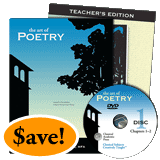
Thus, I was pleased to receive a copy of Classical Academic Press' The Art of Poetry curriculum to review. I received a copy of the The Art of Poetry Teacher's Edition, a copy of The Art of Poetry Student Text, and a DVD with the first two lessons from the Art of Poetry DVD Set.The course is intended for children in middle school through high school.


The goal of The Art of Poetry is to teach students to read closely, to develop a relationship with the poems they encounter. As I learn more about Charlotte Mason's principles of education, I see that children are taught to be close observers of life, of creation. Charlotte Mason said that "education is the science of relations," and Christine Perrin, the author of this program, says that "reading a book is like learning to listen to another person--we have to work to listen and to understand to the best of our ability based on our own perspective and experience." (p. xiv, Introduction to the Teacher) I love this quote from Miss Mason's book, Ourselves, the only volume of her 6-book series written to children:
"There are libraries, too––such libraries! containing every book of delight that ever was written. When anybody sits down to read, the author who made the book comes and leans over his shoulder and talks to him. I forgot to say that in the picture-galleries the old painters do the same thing; they come and say what they meant by it all." 
- C. Mason, Ourselves, Book 1, p. 3
Do you not love the image of your favorite authors leaning over your shoulder, sharing their thoughts with you? I know I do (and I would especially appreciate it if some of the painters would clue me in, too, but that's a topic for another day).

All that to say, I felt a connection with Ms. Perrin and her goals for her poetry program. She states that "literature is asks us to come into relationship with it in such a way that we might be changed and instructed in the way in which we conduct our lives." She then says that "interpretation aids this process. However, writing a teacher's guide that provides interpretations of poems is risky. The concern is that you might not mine the poem yourself if the silver is already there for the taking." (p. xii, Introduction to the Teacher) I appreciate that she knows the danger of simply telling students what a poem contains - she cautions us to be sure we seek and find for ourselves. I believe Miss Mason would have applauded that.

Now, on to the review! There is a *ton* of information in this program. It is organized into three main sections:
  • The Elements of Poetry:  images, metaphor, symbols, words, sound, rhythm, shape (stanza and line) and tone (putting it all together)
  • The Formal History of Poetry: including history of form, movements, genres; verse forms; shaping forms; open verse; and an anthology of narrative poems (see the table of contents here)
  • Application: growing your interest, perhaps with a writer's journal, a notebook of favorite poems, or starting a poetry group, along with many other suggestions
Each chapter in the student book includes an anthology with discussion questions and vocabulary words for each poem, as well as a list of activities. The Teacher's Edition includes everything from the student book, as well as explanations and answers that go along with questions for each poem, and a poetry timeline. Both the teacher and student books have a section with short biographies for each of the poets covered.  There are some great online resources for the course as well: Christine Perrin keeps a blog called The Art of Poetry Online, which includes many teaching helps; audio files of readings of some of the poems from each chapter you can download; and suggested weekly schedules of  different ways you could choose to work through the program.

My girls and I started using the course by watching the first DVD lesson on Imagery. We enjoyed it very much, particularly because the chapter includes a poem by Robert Frost (my favorite poet). I had them work on a couple of the activities, including writing out images for each season, figuring out which of our 5 senses was the most important to us, and discussing images that are important to us. We read the poems in the chapter together, and really enjoyed discussing the images in them. I love Robert Frost's poem, "Dust of Snow," because of the image it creates in my mind. It was a great exercise to verbalize that mental picture.

The second chapter covers metaphor. We love several of the poems in this chapter! "Hope is the Thing with Feathers" by Emily Dickinson is dear to my heart. "Nothing Gold Can Stay" is my very favorite Robert Frost poem, and the discussion questions helped me see things I hadn't before. We also read "I Wandered Lonely As A Cloud" by William Wordsworth, which is a poem Emma loves. It was such fun to look at both beloved and new poems in a new way as we sought out metaphors!

While we did enjoy the DVD lessons, the second one on metaphor was VERY long. We tried to watch it all in one sitting, and in retrospect, we should have watched a poem or two per day and discussed them, rather than trying to absorb them all at once. I found the DVDs to be quite useful, hearing others read the poems and discuss their impressions. It's helpful to see how others analyze poems while we're learning to do it ourselves.  

I am not a "poetry person," if you know what I mean, but I am a poetry wannabe. I am getting every bit as much out of The Art of Poetry as my children are, and I'm enjoying every minute. It's certainly challenging us. We are working our way through the material slowly, so we can learn without overloading our brains. I really like the suggestion in the book of spreading it out over more than one year, because there is so much information to process..

Whether you are a poetry lover who wants to share that passion, or a wannabe like me who hopes to foster a love for poetry in herself and her children, you will find The Art of Poetry to be a valuable tool on your journey. The girls and I are already able to see things in our daily poetry readings that we didn't before, and I look forward to creating our own personal personal anthologies and increasing our knowledge with this program.

You can purchase The Art of Poetry directly from Classical Academic Press:

The Art of Poetry Student Text, $24.95
The Art of Poetry Teacher's Edition, $29.95
The Art of Poetry DVD Set, $69.95
The Art of Poetry Bundle, including student text, teacher's edition, and DVD set, $99

Click to read more reviews from the Schoolhouse Crew!


Tuesday, March 19, 2013

REVIEW: Essentials in Writing, 6th Grade


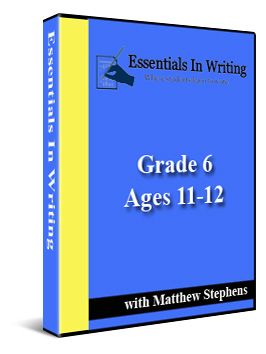
I am a bit obsessive about homeschool curriculum, and I have read about many, many writing programs, but I had not heard of Essentials in Writing before having the opportunity to review it.  It's a complete language arts curriculum, and is available for grades 1-12. I was pleased to receive a copy of Essentials in Writing 6th Grade, and I used it with Emma (7th grade) and Abbie (6th grade).
Essentials in Writing is set up with grammar lessons for the first part of the book (lessons 1-25 in the 6th grade program), and then writing lessons for the remainder (lessons 26-68). There is a video to watch for each lesson, taught by Matthew Stevens, who was a middle school teacher before developing this writing curriculum. I found his lessons to be clear and engaging, and my girls enjoyed them as well. You can see a sample 6th grade lesson here. The recommended approach is to have students look at the day's worksheet, then watch the video and complete the assignment. Once they're done, they should look over the next day's lesson so they're aware of what's coming next.

The 6th grade book covers the following topics (you can download the scope and sequence here):
  • Sentence types and structure, addressing sentence errors as well as dependent and independent clauses
  • Capitalization rules
  • Punctuation rules
  • Grammar:  subject/predicate (both complete and simple, and compound subjects/predicates), parts of speech, subject/verb agreement, propositional phrases, appositives
  • Spelling rules for plural nouns
  • The mechanics of dialogue
  • Figurative language
  • Parts of a paragraph & Writing a paragraph
  • The writing process: pre-writing, drafts, revisions, editing/publishing 
  • Writing a personal narrative
  • Writing an expository essay
  • Persuasive writing
  • Writing a summary
  • Compare/Contrast
  • The process for writing a research paper
  • Poetry (text features/end rhyme, free verse and composition)
My two favorite things about this program are (1) the DVD lessons take me out of the equation for the most part, which is very helpful with a busy 5-year-old in the house and (2) short lessons, so that even when there is a project that will take longer to complete, it's broken into bite-sized pieces so it's not overwhelming. One thing I wished for while we were doing the grammar lessons was an answer key, because every now and then I wasn't 100% sure of the correct answer, and while I was flipping through workbook to write my review I found it in the back. Aha! The good news is, the girls made enough mistakes that I know they haven't discovered it yet for themselves. :-)

Both girls enjoyed using this program. Well, the younger one said she didn't mind it, which means she liked it a lot. :-) The older one felt that it was easier to understand than the other program we'd been using, and I attribute that to the DVD lessons. She also said she would not complain when we continue to use it. That's some high praise from my "tweenagers," I assure you.

I did learn while working through this program that my girls really need practice reading directions and completing an assignment by following a given example. We've done informal grammar instruction up to now, and our writing has been primarily copywork and narration, so they have not done many worksheets. Once they did their EIW lessons, we went over them together, and that made for some good discussions. When I pointed out mistakes, they were able to see what they'd done incorrectly right away, and I hope it's helped them see that reviewing their work before turning it in is a good idea.

Each level of Essentials in Writing is $40. You will receive two DVDs with the lessons, and a PDF copy of the workbook via email. It's a good-sized workbook, and they also have a pre-printed Optional Workbook available for $20 if you'd rather not do the printing yourself. When I had questions, I received answers quickly and appreciated their customer service.

I like this curriculum. I like that both grammar and writing are taught, and how each year builds on previous knowledge. I love that poetry is included! It's a great program at a great price. It's definitely worth checking out!

Click to read more reviews from the Schoolhouse Crew!


Monday, March 18, 2013

REVIEW: TouchMath


My little guy turned 5 in August, so even though I would not have sent him to school this year, if we were going that route, we've done some kindergarten work. Overall, it has not been going well. He doesn't want to sit still, and has strong opinions about whether or not he should have to do any school work at all. It's not that he can't do it; he's quick to grasp things, and once he decides to cooperate, it goes quickly. I do spend quite a lot more time getting him to do the actual work than he spends doing it, though.


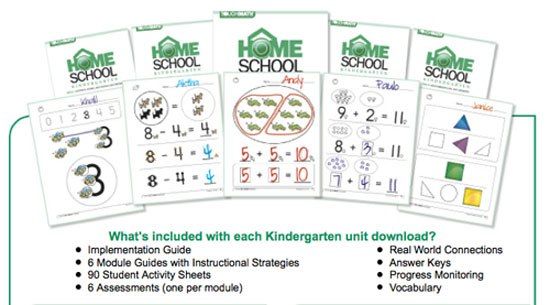
I've been revising my plan over the last few weeks, and felt it was best to pare back to some reading instruction and a little math. When the opportunity came to review TouchMath, I was excited to use it with Isaac. We were both thrilled to receive our box, and quickly got everything out to play. For the purpose of this review, I received downloadable versions of all 4 TouchMath Kindergarten Homeschool modules, A-D. There are 6 units within each module.

  • Module A focuses on Counting, Adding and Subtracting within 5
  • Module B focuses on adding and subtracting within 5
  • Module C focuses on understanding numbers 1-20
  • Module D focuses on measurement, data, and geometry. 
In addition to the core program, we also received the following fun manipulatives to use:  TouchMath Tutor Kindergarten Software, TouchShapes,


and 3-D Numerals. Note: The manipulatives are optional, and not required to use the program.


Isaac *loved* all the manipulatives. We started out with learning the touch points on the numbers, and he caught on quickly. He liked to get them out and practice on his own. He enjoyed using the TouchShapes during the lessons, and liked using them to make pictures on his own. He's always up for a game on the computer, and he liked having a special math game just for him.

"Mommy, is this a rhombus or a  hexagon? Very good, Mommy!"

One of the first things we did was learn to count to 100. I remember practicing this with my girls when they were older than Isaac, so I wasn't sure how it would go, but he caught on lickety-split. I loved how the worksheets had him start counting in a random place and continue from there, or fill in numbers in the middle of a sequence. It made him think about the numbers, and he did very well. 

 Counting to 100 - fun with Cheerios!

As we got a little further, I thought some of the activities were a bit simple. I didn't see why he needed to circle groups of shapes, for example, until I remembered from the teacher training video how crucial it is to connect manipulatives and pictures with the abstract numbers. By circling groups of 2, he is learning to see what a "2" means.


TouchMath recommends using the program for 2 - 2.5 times your child's age, which would be 10-12 minutes per day for my 5-year-old. On a typical day, we would try to work on a set of activity sheets, which were in sets of 2-4 pages in the  Implementation Guide. Sometimes, we got them all done, and other times, we might get through one. He liked the computer software, so I encouraged him to practice on that, and he was almost always willing.

As we began to use the program, I was concerned that I was missing something. I had read the teacher's instructions, but didn't feel I had quite enough information. I confess that I am an anxious math teacher. I went to the website and ordered their free teacher training DVD, even though I wasn't sure I'd get it in time for the review. It arrived via Priority Mail in just a couple of days! I was thrilled with the quick turnaround. I watched the DVD, and it was very helpful. They also included a "Teacher Training Manual," with much of the information presented in it, and practice problems for each thing presented. It was excellent, and I felt much more confident after I'd viewed it.

I have been impressed with their excellent customer service. I had a question about the software, and was able to get an answer quickly. Also, we had an issue with one of our manipulatives, and they sent us another one right away free of charge.

I really, really like this program. I love the statements that children are given to memorize, like "I start on the side with the arrow. The arrow is in the ones column on the right side." Also, for addition with regrouping, they put a box over the next column, and for subtraction, they use a "regrouping bar," which is a line, instead. My girls were often confused with regrouping and would add instead of subtract, etc. Those visual cues are excellent.

TouchMath was created because an elementary teacher saw her beginning math students having difficulty, and wanted to help them. The focus was initially on students with special needs, but has grown into a math program for anyone. I love this quote from their website: "During the next thirty years, our goal is to help banish math anxiety worldwide, whether that anxiety is born of fear, lack of comprehension, or a learning disability." I have a daughter with quite a lot of math anxiety, and I wish I'd known about this program when we were starting our math journey. I think it would have made a huge difference to her.

I've spent a lot of time stressing over math in my homeschooling career, and while using TouchMath, I felt I could teach it successfully for the first time. The way they explained the concepts made so much sense to me, which made it easy to explain to Isaac. I was amazed at how quickly he learned things while using this program.

Product Pricing:
TouchMath Homeschool Kindergarten Modules, A-D: $59.95 each, or $199.00 for all four
TouchMath Tutor Kindergarten Software, $99 
TouchShapes, $30
TouchMath 3-D Numerals, $79

Click to read more reviews from the Schoolhouse Crew!


Friday, March 15, 2013

What's For Dinner?

We often have pizza on Fridays, but tonight we're having something different. I thawed a top round/London Broil yesterday, intending to have it last night, but I'd forgotten that it's not the best choice for grilling. I'm putting it in the crock pot this morning, instead.

I thought I'd share the recipe. It's one of my family's favorites, and it's nice and easy. I'm not sure where I got it. I think it came from a bunch of homeschool moms sharing recipes online, as we are wont to do when the "what are you making for dinner" question arises. I love slow cooker recipes, because when 4 o'clock comes around, I don't have to worry about getting much together because it's already done.

Crock Pot Flank Steak

1 flank steak, approx. 1.5 lbs, cut in half if you have a small crock pot*
1 Tbsp oil
1 large onion, sliced
1/3 C water
1 can (4 oz) chopped green chilis
2 Tbsp vinegar
1 tsp chili powder
1 tsp garlic powder
1/2 tsp salt
1/8 tsp pepper

*I use top round/London broil because that's what I usually have

In a large skillet over medium-high heat, brown steak in oil. Transfer to crock pot. In the same skillet, sautée onion for a minute or two.Gradually add the water. Add remaining ingredients and bring to a boil. Pour over the meat in the crock pot. Cover and cook on low for about 8 hours or until the meat is tender. Slice and serve with the onion and pan juices.
I usually serve this with mashed potatoes, but we had those last night, so this time we might go with baked potatoes and a salad. If you try it, let me know how you like it!

Wednesday, March 13, 2013

Nature Study Moment

Monday morning, I went for a walk before the kids were ready for the day. I was able to identify the sounds of a woodpecker knocking on someone's tree, a Carolina wren tea-kettling, a tufted titmouse singing, and a mockingbird chattering away. It was lovely! I heard lots of other birds I couldn't identify yet, but I'm working on it.

I also found a Northern Flicker at the side of the road, so I brought it home to show the kids. I think the neighbor's cats got it, but it wasn't bloody or anything.

Such a beautiful bird! I had never seen one before. I looked it up in our bird book, and there are two kinds: red-shafted and yellow-shafted. I found one of the yellow-shafted variety.


Look at that beautiful wing! I loved the heart-shaped spots on its belly near the tail. And that beak - I am glad it wasn't aiming at me.

Poor thing, I couldn't leave it by the side of the road. My dad used to bring stuff home for my brother, sister and me to see all the time when I was growing up. He brought home a baby skunk once! My mom was less impressed with that one. We found two small owls in the road once - apparently they'd been chasing each other and been hit by a car.

How often do you get to see a wild bird up close? We have bird feeders, and we all love to watch the birds outside, but this was a great opportunity to observe details we wouldn't otherwise be able to see. This was a big bird - much heavier than I had expected.

I am not the only homeschooler who brings home dead things. :-D Have you found any cool stuff on your nature walks and brought it home for futher exploration?

Monday, March 11, 2013

REVIEW: ARTistic Pursuits Art Curriculum


True confession: I have not done very much art instruction with my girls. (I haven't done much with Isaac, either, but he's only sort of in kindergarten so I don't mind so much.) Art is one of those "extra" things that only happens when there is "time." I don't have much confidence in my ability to teach it well, either, so most often it slides to the back burner. I've looked at ARTistic Pursuits before, and I have a couple of their books for younger children. When we've used them, the girls have enjoyed them very much. However, they typically fall by the wayside in the name of getting MATH done, you know?

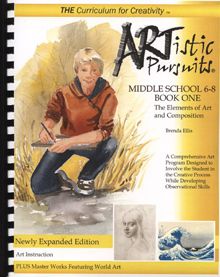
I was therefore thrilled, and a bit trepidatious, at the opportunity to review one of their brand-new, updated books. I received  Middle School 6-8 Book 1: The Elements of Art and Composition, available for $47.95 from their website, for the purpose of this review. It's a nice comb-bound book, so it lays open easily while we're working on lessons. It's directed at ages 11 and up.


The topics are organized into 16 units, and each unit has four lessons:
1. Building a Visual Vocabulary
2. Art Appreciation and Art History
3. Techniques
4. Application
Assignments are color-coded in gold, so it's easy to see exactly what they need to do. Students should plan to spend approximately an hour on each lesson. If they do two classes per week, the book will take 32 weeks to complete. The author notes that it is important to schedule art lessons when the student will have plenty of time to complete the assignment, even if it takes them more than an hour. That's a good reminder - it's hard to stop in the middle of a drawing and find your "groove" again when you come back to finish it.

The book is written in a lovely narrative style to the student, so my girls have been able to do the lessons without my direct supervision. I had initially hoped to be able to work through it along with them, but it didn't work out that way. They've been doing a great job on their own.

The supplies needed for this particular level are simple: drawing pencils and paper, pen & ink. We had many of required items and it wasn't difficult to find the rest. ARTistic Pursuits offers supply packs for each level, which are great if you're not sure what to buy or can't find what you need locally. It also makes it easy to get everything you need in once place so you're ready to start when your box arrives!

Because I have older editions of two of the books for younger ages, I contacted the author and asked if they were compatible with the newer editions. She responded quickly, and told me that the content is the same, with some added pages, so older and newer versions are compatible. Good to know!

I asked my girls what they liked most about the program, since they've been drawing away without me. My older daughter said she liked that the book was written to her (the student), and that there were specific instructions to follow. She and I are similar that way - we don't respond well when we're told to do "something." We like to know exactly what's expected. My younger daughter liked drawing household objects, and learning to look at things that are around us all the time from a different perspective. She also liked using several different drawing pencils in varying degrees of hardness in her pictures.

The first unit talks about space. One of the assignments was to draw a quick sketch from a painting, titled "Portrait if the Elephant, Dal Badal, Chasing His Attendant." They were to sketch the picture on a full sheet of paper, and then on a half sheet of paper. They both did the assignment, but my older girl lost her pictures. For some reason she didn't do them in her sketchbook, and they've wandered off. My younger daughter did a great job, though! Check it out!


Here are some of my younger daughter's other drawings:

Clockwise from top:
Illustration of the story of the 6 blind men and the elephant; our bamboo plant; daffodils; and her Bible verse memory cards on a ring

Here are some of my older daughter's drawings:

From left to right:
Her cat who hates everyone else; illustration of the 6 blind men and the elephant; daffodils

I've seen improvement in their drawing skills in the few weeks they've been using this book. The main thing is practice! With a book to follow and specific assignments to do, they spend time drawing regularly, incorporating new skills along the way. As they've worked through the lessons, they've seen they CAN draw, and their confidence has increased. My older girl would rather not bother with drawing most of the time, but she has enjoyed this book and I've been pleased with her work. My younger girl loves to draw, but is a perfectionist, and has a hard time believing in herself. I've seen her smile over projects she's created over the last few weeks.

Probably my favorite thing about the program is that it is teaching the girls to observe the world around them. In our Charlotte Mason homeschool, careful observation is key. Education is relational; all subjects are interconnected throughout Creation, and the only way to find those connections is to observe carefully. I love seeing how much more closely the girls observe things while they're drawing them.

I also love that art appreciation is included. We get to see pieces of art from famous painters as well as ones who are new to us, and each one is carefully selected to illustrate the topic for the unit. There is information about not only the artist, but the culture during the time the piece was created. We do have our own artist studies, but I appreciate the exposure to new works we haven't seen before.

I love this art book, and plan to have the girls continue working through it. I feel inspired to get out my kindergarten book for Isaac to use, too. ARTistic Pursuits offers art instruction for all ages: Pre-K, Early Elementary (K-3), Elementary (4th-5th grade), Middle School (6th-86th grade), and High School.  Don't forget those handy supply packs, which come with a bag to keep everything in one place. As a mom who wants to teach art but doesn't have any previous knowledge, I highly recommend this curriculum. I hope you'll check it out!

Click to read more reviews from the Schoolhouse Crew!