Pages

Wednesday, May 22, 2013

REVIEW - Educational Dice Bag from Joyce Herzog


I recently received the Educational Dice Bag from Joyce Herzog to review through the Schoolhouse Review Crew. I'm always interested in new (at least to me) educational products, and my kids LOVE to play games (don't they all?), so this was right up our alley.

Joyce Herzog is an educator with 25 years experience teaching elementary and learning disabled students in both private and public schools, and has served homeschoolers for more than 25 years through her speaking engagements, the books she's authored, and consultations. She wants to help students learn as they learn best, according to their individual learning style.

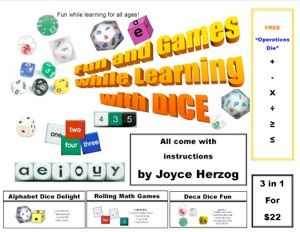
The Educational Dice Bag comes with three sets of dice: Alphabet Dice Delight, which includes a 30-sided alphabet die (all the letters plus four "wild" spaces) and a vowel die (AEIOUY); Rolling Math Games, which includes 1 die with numbers, one die with number words, and two dice with colored dots; and Deca Dice Math Games, which includes 1 deca die with numbers, 1 dotted deca die, 1 number word deca die, and 1 double deca die (a die within a die - so cool!).  There is also a math operations die. Each bag contains instructions for simple games to play. The label says "fun for all ages," and that's certainly true. There is a game in there for everone.

Alphabet Dice Delight, Rolling Math Games, and Deca Dice Math Games
My children all enjoyed playing with these dice, but I used them most with my 5-year-old. Many of the games are just perfect for him at this age, and he loves to play with me. Once he's learned something, he loves to teach it back to me, so I got to brush up on my addition and alphabet skills, as well. :-) This is a quick, easy thing to get out when we have some time to fill while the girls are working.

I gave Isaac a printed alphabet chart, and we played one of the recommended games, which has him roll the alphabet die with lower case letters on it, and match the letter that comes up with the corresponding upper case letter. He was really good at that game, and it was helpful for me to see that he does, in fact, know all of his upper case and lower case letters. The die also has a few "wild" spaces, so when that would come up, he could choose any letter he wanted. Turns out his favorite letter is "A."


Take a look at that picture on the right. He rolled those dice and told me that added up to 7. I was so impressed! It's probably not that big a deal, but I was pleased to see that he could process dots and numbers together. He did put away the die with number words on it after I made him sound out and read "six" to me. I guess that was not in HIS rules for that game. 


Once we have finished with the games I ask him to play, he loves to make his own fun with the dice. I have yet to find something that will not allow Isaac to bring cars into it somehow, and as you can see, his little trucks are excellent at hauling the dice away.

There are games in here for older children, too. You can use the alphabet die to teach kids how to use the dictionary. How cool is that? The deca dice math games, in particular, would be challenging for older kids. There is even a game for practicing long division!

I really, really like the dice and the game instructions. The games are simple, so not hard to figure out, but they teach great stuff. For example,the instructions encourage you to have students keep score using tally marks, and then learn to count their points by 5. That's a nice little trick for slipping in some extra skip counting practice.

What I love:
  • Connecting with my kids as we play together.
  • The games are fun, and they give students great practice in important skills. 
  • The dice are portable! The instructions suggest keeping them in a small plastic container, and taking it with you to the doctor's office, etc. so you always have something to do. Isaac and I spend a lot of time waiting for the girls at their various activities, and it's been fun to play dice games while we hang around at the dance studio.
  • NO ELECTRONICS INVOLVED.
The only thing I would suggest improving is perhaps printing the game instructions in a larger font. My old-ish eyes had a hard time reading them. I know it's to keep the paper small so they fit easily into the bag, but I'd take a little extra paper for ease of reading.
The Educational Dice Bag is available from the Joyce Herzog Products Store for $23. You have to create an account to get into the store, but it's simple to do. The Schoolhouse Crew reviewed several Joyce Herzog products and I hope you'll check them out!

Click to read more reviews from the Schoolhouse Crew!

Wednesday, May 15, 2013

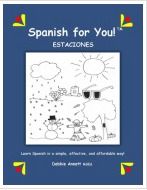
REVIEW: Spanish for You! Estaciones Spanish Curriculum


It's important for children to learn another language. Not only do most colleges expect it, but it teaches them a whole new way of thinking. Other languages work differently than English, and it is a good brain workout! We have struggled to implement foreign language in our homeschool; the girls haven't been terribly motivated and we've had plenty of other things to keep us busy. They took an excellent Spanish class at out homeschool co-op, but they only went twice per month. Foreign language instruction really needs to be more often that that.

I was intrigued when I looked at the Spanish for You! curriculum, and pleased to have the opportunity to review it. Spanish was a good place for us to start, since the girls were a little familiar with it already. We received a physical copy of the Estaciones workbook; downloadable audio files of the entire book, including audio with a native Spanish speaker; PDF downloads of self-correcting worksheets, a weekly lesson guide, and flashcard/activity game pictures. It's a year-long program (24-27 weeks), intended for grades 3-8, and the recommendation is to use it 4 days per week.

Debbie Annett, the author of Spanish for You!, has been teaching Spanish to all ages for 14 years, and was in international business for 8 years before that. She spent time studying in Spain. She wrote this curriculum to be effective, flexible, and affordable, and to work for multiple ages, with or without prior Spanish experience. She wanted to create a program that would flow well into any high school Spanish program. Because each book is written to be used with many ages and levels, they are theme-based, rather than leveled by grade. Currently, there are two books available: Estaciones (Seasons), and Fiestas (Celebrations). A third theme, Viajes (Travels) is available as a short trial unit; the complete package will be available in June 2013.

As we began to use this program, I was a little confused. It's very different from how I remember learning Spanish! I finally decided to STOP trying to remember what little I knew of Spanish and just go with the way the program was written - and I have been VERY impressed.

As a Charlotte Mason homeschooler, I've been trying to learn how Miss Mason would have implemented foreign language instruction. I've heard a lot about Gouin Sequences, and have recently started to learn how they work. François Gouin was a French teacher of Latin who tried to learn German as he had learned Latin - through grammar and translation. Apparently he memorized thousands of German words, translated Goethe and Schiller - all without actually speaking to someone in German - and found he could not hold a conversation with a native speaker. He ended up having children teach him simple phrases, like "Open the door." He found the key to be speaking and interacting with a language.

This is what I found in Spanish for You! Our book, Estaciones, is about seasons. We've learned the days of the week, the months, of the year, and how to talk about the weather, as well as things you can do in each season of the year. From the beginning, we learned to say things that we could put into action - to look at things, to write things, to draw things. Each unit starts out with vocabulary, and making flash cards; then some verbs and conjugating so you can use the vocabulary, and then some grammar, so you see how it all works together. The flash cards are not for "kill and drill," by the way; they are to help the students connect with the words while they make their cards, and then there are several options for activities using them listed in the front of the book. As we've learned more and more words, we've been able to speak to each other in Spanish a bit. We're able to use the language - and that is key to being able to think in it and speak it well.


When we received our downloads, I saved them to the computer, and printed out the 7-8th grade lesson plans and the first set of worksheets. On our first day, the girls made flash cards. They had a GREAT time doing this. I forgot that images were included for the cards in a PDF, so they made their own.


Once the flash cards were made, we moved on to practicing what we'd learned. First, we had just a few commands - "Mira," which means look, "escribe," which means write, and "dibuja," which means draw. With a piece of paper in case they needed to write or draw, I read the commands and they would do them. It got to be more fun when we learned a little grammar, and could ask each other about the weather, what month it was, what the weather was like during a particular month, etc. My girls are at that tween/early teen age when they can't admit to having fun with anything, but *I* enjoyed speaking Spanish with them, and I think they enjoyed speaking it with me, as well.

Ms. Annett offers wonderful support for her program. She answers questions very quickly, and is responsive to feedback. During the review period, she changed how the downloads were organized to make them easier to use. Two things I'd like to see:
  • Worksheets in one file for each grade level, instead of lesson-by-lesson; I'd rather print them out once
  • Answer keys in a separate file
Each level of Spanish for You! is available to purchase as a complete package for grades 3-8 for $64.95, or per grade level (3-4, 5-6 or 7-8) for $39.95. Extra books are available for $12.95 each. With each package, you receive:
  • Soft cover book
  • PDF Download of the 24-30 week lesson guide for the grades you need (Click for sample)
  • PDF download of self-checking worksheets (Click for sample)
  • MP3 download of audio files of the entire book (including bonus audio of native speaker reading the entire book)
  • PDF download of flashcard/activity pictures
This is a great program. You don't need to know any Spanish to teach it - the audio files read everything for you! If you're looking for a simple, affordable way to teach Spanish in your homeschool, I hope you'll consider Spanish for You!

Click here to read more reviews from the Schoolhouse Crew!


Thursday, May 09, 2013

REVIEW: Papa's Pearls


It's no secret that I love books, so when the opportunity came up to review Papa's Pearls: A Father's Gift of Love and Wisdom to his Children and Grandchildren by Diane Flynn Keith, I jumped on it. It sounded like a wonderful book - a glimpse into life during the Depression Era, as well as "pearls" of parenting wisdom to share from Diane's Papa, Carol Flynn.  Dianne, in addition to being Papa's daughter, is an alternative education specialist, parenting coach, and author of a nifty-sounding book called Carschooling: Over 350 Games & Activities To Turn Travel Time Into Learning Time. Check out her other website, Homefires.


I was not disappointed. I loved reading this book, laughed a lot, and even cried during parts. I treasured reading it with my children, because it inspired some wonderful discussions. It's written to parents, intended to help you pass on some solid, practical knowledge to your children. It's well written, very much what I would consider a "living" book on parenting, and a quick read. I think it's within easy grasp of middle school students, but I would say it's best shared as a read-aloud, so you can discuss things as you go along. There is nothing horrible, but there are some situations you'd want to talk about when they come up in the book.

Diane's Papa, Carol Flynn, grew up in a family where illegal activity was accepted as the norm. When he was a teenager, he was sent to reform school. While he was there, he learned useful trade skills, and more importantly, came under the influence of a great mentor: his teacher, Mr. Brammer. Instead of letting the experience send him further down a path defined by bad choices, he used it to turn his life around, and became a true example of the American Dream - a man who made a success of himself through hard work and perseverance, and lived by the Golden Rule.

Each chapter of the book shares one or more of Papa's bits of timeless wisdom, along with sweet memories of Papa from his children and grandchildren. He taught his children to be independent and responsible, and gave them plenty of opportunity to develop their "street smarts" - to learn common sense and how to handle themselves in just about any situation. He also gave them a strong foundation of love and the confidence that comes from knowing your parents are always on your side. That didn't mean they didn't suffer consequences for making bad choices - they did - but Papa always made it a learning experience. For example, when he caught his son smoking with his friends near their gas meter, he didn't yell - simply asked his son, "What were you thinking?" and then told him if he was old enough to smoke, he was old enough to work, and had his son come to work with him in his plumbing business every day after school when he didn't have another activity planned. Not only did this keep the boy from having too much free time to indulge questionable choices, he learned a lot about plumbing, how to manage his time well, and to follow through on a job.

When I read this book, occasionally I felt like a pretty good parent. My children are very familiar with the ideas behind, if not the exact wording of, phrases like:

 "When you fall down, get back up, brush yourself off, and try again." 

"Ya gotta do what ya gotta do." 

"I love you. You know that, right?" 

"Let it go, like water off a duck's back." 

The look they would get on their faces when they heard someone else saying things they hear often from their dad and me was priceless! I wish I'd been taking pictures.

I also felt challenged to be a better parent. Papa was not prone to lose his temper; no one talked about him yelling. I tend to yell; I can do better. Papa was also an intentional person and parent. He did the best he could do in every situation. Also, he was kind. He put his family first, but was always willing to offer a helping hand to someone in need. One of my favorite stories in the book is about a toothless, unkempt man named Andy who lived in a shack next door to Papa's plumbing business. Papa gave him a job, and introduced him to anyone who came to the shop. He honored the dignity of a man that many people, then and now, would probably prefer to ignore.

My favorite was chapter 10, when Dianne told how Papa always put his family first, and would tell anyone how proud of them he was. One precious memory from his granddaughter, Katie, was his telling her that he would say hello to her photo every day. Papa had a way of letting his family know just how important they were to him. That was the part that moved me to tears. I had grandparents who loved me like that, and I treasure their memories. I hope to leave a legacy of love like that for my children and, Lord willing, my grandchildren.

I hope you will take the opportunity to read this book. It's available for $14.97 plus shipping and handling from the Papa's Pearls website.

Click here to read more reviews from the Schoolhouse Crew!


Tuesday, May 07, 2013

Day 6 - A Favorite Author and Day 7 - Onomotopaeia

I had the HARDEST time coming up with just one favorite author yesterday - so I decided on two. :-)

For older children, I love, love, LOVE Edith Nesbit. I can't remember now how I discovered Five Children and It, but I loved it, and went on to read The Story of the Amulet and The Phoenix and the Carpet. Then, I found The Enchanted Castle, The Wouldbegoods, The Railway Children... all of her books are wonderful. I most recently read The House of Arden, and Abbie is reading that now. Her children's books are wonderfully imaginative, with adventure and magic awaiting the main characters, who are always children. They usually get in some kind of trouble, and have to get themselves out of it.  These are the kinds of books one can get lost in, you know? I highly recommend them.

She also wrote a book about the importance of imagination called Wings and the Child or, The Building of Magic Cities. It's available for free on Kindle. Give it a read if you have a chance. Here's a quote for inspiration:
I would have every man and woman in whom the heart of childhood still lives, protest, however feebly and haltingly, yet with all the power of the heart, against machine-made education—against the instruction which crams a child with facts and starves it of dreams, which forces the free foot into heavy boots and bids it walk on narrow pavement, which crushes with heavy hand the wings of the soul, and presses the flower of imagination flat between the pages of a lexicon.
For younger children, I can't think of anyone better than Beatrix Potter. Is there any child who does not love Peter Rabbit? Who wouldn't be drawn in by Mrs. Tiggy-Winkle or Jemima Puddle Duck? My personal favorite is The Tale of Benjamin Bunny. Benjamin is rather fractious and gets into all kinds of trouble, though he does assist Peter in getting back his clothes that he lost in Farmer MacGregor's garden. My 5 year old boy loves to read about the Fierce Bad Rabbit.

The language in these stories is simple, but lovely. In addition, her illustrations are beautiful. Please, please read the original writings, and avoid anything abridged or reworded. If you want a good collection, try this one.

Now, on to onomatopoeia. Isn't that a fun word? It's also fun to find it in books. A fairly recent find is Alphabeep: A Zipping, Zooming ABC by Debora Pearson. Isaac loves to read about construction vehicles, or any kind of vehicle, really. I enjoy reading this one more than some he's found. Here is a quote:
A is for Ambulance, that makes alarming sounds. Shrieking, wailing, whooshing by, it's in a rush to help someone.
Another fun one is Chicky Chicky Chook Chook by Cathy Maclennan. This is another board book, and Isaac enjoyed it when he was littler. I love the sound of the thunderstorm: "Crash, bang, WALLOP!" Isn't that great?

I feel like my onomatopoeia examples aren't the best, but they're what I found when I was flipping through the picture books. I'd love to hear if you have better ones!

Sunday, May 05, 2013

Day 4 - A Favorite Cover and Day 5 - A Green Message

We had a busy day yesterday, so wasn't able to get my book posts done. My daughter had a choir engagement that took up most of the morning and early afternoon, and then we went to collect our very first foster puppy, Lucy! Isn't she cute?


All righty then, on to the books!

Day 4's topic is a favorite cover. Here is mine:


Here is the spine:


And here's the back:


I love how the picture wraps around the entire book. Isn't it just lovely?

My grandparents gave me this book in 1980. They were tremendous readers, also. Seeing this reminds me of that, and I wish I'd asked them more about the books they enjoyed when they were still alive. This beautiful copy of Little Women by Louisa May Alcott is one of my favorites stories, and one of my most treasured books. It's illustrated by Louis Jambor. He also illustrated Jo's Boys. I did a quick Google search on him, and all I learned was that he was an American painter, born in 1884, and died in 1955. If you know anything more about him, I'd love to know!

Now, as for Day 5, a book with a "green message." I don't know if this book is exactly green, but it's about making the world a more beautiful place:  Miss Rumphius, by Barbara Cooney.

Even the cover of this book is beautiful - certainly a contender for Day 4, as well. 

A couple other green books I could think of: The Lorax, by Dr. Seuss, and On Meadowview Street, by Henry Cole.

Friday, May 03, 2013

Day 3: A Book I Love To Read Aloud

This is a tough one - how do I choose just one book I love to read aloud? I had to think hard to answer this question.

I finally decided on Farmer Brown Shears His Sheep, by Terri Sloat.


I got this book when the girls were small, and I love it. It rhymes, which I've found makes any book easier to tolerate for repeated readings. We read this one a LOT. "Farmer Brown was shearing sheep, piling up a snowy heap, of wool that filled his shed knee deep. Clip, clip, buzz, buzz, he took their wool and left them fuzz!" See? I still have it memorized! Good thing I enjoy it so much. I will read it any time. My girls, who are 12 and 13, still like to hear this one.

It also talks about the process wool goes through, from shearing to knitting, which I thought was cool. The "crisis" in the book is that the sheep decide they're cold after they're shorn, so they follow Farmer Brown, trying to retrieve their wool. Do they win? You will have to read the book to find out!

Unfortunately, this book is out of print and it's not cheap to get a used copy. You might be able to find it at your library, though.

What's your favorite book to read aloud? I am always looking for book suggestions, so please leave a comment and let me know!

Thursday, May 02, 2013

Days 2: A Book That Makes My Children Laugh

Lots of books make my children laugh! Since I have three, I decided to ask each one of them what book came to mind for this topic.

My oldest said Pishtosh, Bullwash and Wimple by James Flora.


This is a book I remember checking out from the library over and over again when I was young. My friend Sue, who is a librarian, helped me find a couple of used copies, back before buying books on the internet made it a much simpler process. I was SO excited! I opened it up, read it and . . . saw that it was twaddle. However, it's still a fun childhood memory for me, and it's such a silly book that all my kids giggle when we read it.

My second child chose The Best Christmas Pageant Ever by Barbara Robinson. I was surprised - this is one that their grandmother reads with them, so I tend to forget they've heard it. Originally published in 1971, it's one I enjoyed as a child, too, so that makes it even more fun to talk about it with mine. My favorite quote is: "Hey! Unto you a child is born!" (p. 108) :-)


My five year old chose There Are Cats In This Book by Vivian Schwarz.  My sister-in-law, Jennifer, a fellow bibliophile, gave him this book, and we love it. It's so silly. We love cats anyway, and this book is a fun read. Isaac loves to blow the cats dry. You will just have to read it to see what I'm talking about.


As for me, my go-to author when I want a laugh is Patrick McManus. My kids could read him too, if they were so inclined. Another good author for giggles is James Herriot. That man survived his career as a vet through a series of miracles, I tell you. Good stuff.

I'd love to hear what books make your children - and YOU - laugh! Please tell me in the comments!

Wednesday, May 01, 2013

Day 1: A Classic Children's Book


Elizabeth Foss posted this nifty little meme about children's books, and I thought I would chime in. I don't have a clue about Instagram, so I will just play along over here. Feel free to join me - I would love to see your book list, too! When possible, I will include a link to Amazon for the books I mention (I'm not an affiliate).

Day number one is a classic children's book. As I looked over the list of topics this morning, I could tell it's going to be difficult to choose just one book for several of the themes. However, if there is one book I think every child should have read to them, it's Winnie the Pooh by A.A. Milne. I have the unabridged audio book, too, and all three of my children have enjoyed listening to it in the car. *I* enjoy listening, too.


I have my dad's vintage Pooh books, and I do treasure them. They are just such fun stories, and they teach good things about friendship, doing the right thing, and courage in the face of fear.

I beseech you NOT to get any of the Disney-fied Pooh books. The language has been changed, for reasons incomprehensible, and they're just not worth your time. There is nothing difficult about the original books, and children will not have any trouble understanding them. There have been a few smaller books made of individual stories, like this one, if you feel you must have a picture book version.  Otherwise, just go for the real thing, and keep the readings short for younger children. My son, who is 5, can handle one chapter at a time, usually.

What is your favorite classic?


Monday, April 29, 2013

Spring Has Sprung!

It's been a chilly spring here, and it's hard to believe it's almost May! For those of you who still have snow, here are some pictures to brighten your day.

Tiny Violas, growing wild in the yard
The Dogwoods are Almost Done
Coral Bells are Getting Ready to Bloom
Pinks are Pinking
I can't believe the rose bush already has blooms!
Separated the iris in the fall, and wasn't expecting flowers this year!
Even a bud on the peony!

Is there anything better than fuzzy dandelions?


Wednesday, April 24, 2013

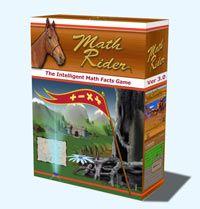
REVIEW - Math Rider


My girls LOVE horses. Love them! The oldest started asking to ride a horse at around age 3, brainwashed her sister, and the mania has yet to leave our household. This same oldest child of mine hates math, and has had a terrible time memorizing math facts. We've done worksheets, copywork, flash cards, Math Shark, Little Professor, computer games, board games, and sing-a-long songs. I even snuck a math game onto her Amazon wish list for her Nintendo DS, which her grandmother purchased, and said child hated. She just hasn't been able to get her math facts committed to her long-term memory.


When the opportunity came to review Math Rider, I was cautiously optimistic. The horse part sounded good, but after all our other trials and failures into the world of math fact memorization, I just didn't see how it could be any more effective than the other things we'd tried. Still, it involved horses. There was a glimmer of hope. The program is aimed at children ages 6-12, or older children who still need to master their math facts. The game accommodates up to 8 players. Thomas Brand, the creator of Math Rider, developed the game because his own children were struggling with math.

Wonder of wonders: It has been easy (gasp) to get my girls to practice their math facts. They *like* it. I never thought I'd be able to say that! My math-loving daughter has already made her way through most of the levels on all four operations. My math-hating daughter is taking a slower pace, working on the easy levels first, and getting ready to move on. They have both shown improvement when I've worked with them on their math.

Each operation (addition, subtraction, multiplication, division) has four levels, from "Easy" to "Master." Each level involves a different quest. For example, the "Easy" level involves the rider's mom having the flu, and the rider is told they will have to fix all meals until their mother gets better. The only cure is the Pythagoras Flower, so the rider sets off on a quest to find it. The four quests are the same across the operations, with a different reward for each quest. There are thirty questions, and thirty jumps, for each section of a quest. Each level requires a certain number of points for completion. The Easy level requires 500 points, Medium requires 750 points, and so on. You do have to complete each quest before moving on to a new one, which makes sense. You can't start doing addition and switch to another operation before your current quest is completed.

I signed myself up as a player so I could understand how it works. The game controls are simple, which is a deliberate part of the design - Mr.  Brand did not want to see a child unable to succeed because of the game controls. When you're answering questions, you use the number keys on your keyboard to type your answers in, and then hit "Enter." When you answer correctly, your horse goes over a jump.  If you enter your answer correctly, you hear a note or a "star" sound. If you answer incorrectly, your horse snorts, and you can re-enter your answer. If you hit a key by mistake, you can hit "Delete" and re-enter your answer, as long as you can do it before your horse gets up to the jump. You can pause the game by hitting the Escape (Esc) key, and turn the music on or off by hitting the "M" key.

The program is "smart," so it adapts to each player. Each student practices the problems they don't know as well but not the ones they have mastered. Each time you complete a portion of the quest, you see a screen that shows whether you've answered the questions correctly or not. There are green bars indicating correct answers, and yellow and red bars which indicate slower or incorrect answers. There is a statistics screen where you can see your overall progress.

The program uses Adobe Air, which means it runs on both Windows and Mac operating systems. This was a huge point in its favor, as we use Macs at our house, and so many programs are written for only Windows. You can see the complete list of system requirements here.

What I like:
  • My children enjoy the game, so it's easy to get them to practice math facts.
  • The statistics screen to monitor progress
  • The adaptability of the program to meet the needs of each player
  • The positive reinforcement when they complete quest, telling them they are a "master of addition," etc. 
What I like less (small details, and not ones that would prevent us purchasing the product):
  • Although you can turn the music off, you have to turn it off each time you play a new section of a quest. I would prefer to turn it off, and then opt to turn it back on myself. I did mute the computer, but then I couldn't hear the horse snort when I answered incorrectly.
  • At the end of each section, you have to watch your points count out. I would love a way to be able to skip over that.
My child who "doesn't like math" is simply a child who struggles with it. This game has been so good for her, because she wants to play. What she needs most is consistent practice, and she's getting it now, and I don't have to make her do it. That, I believe, is the key. While I am not always an advocate of more screen time, in this instance, I will make an exception, because I can see how much it's helping her.

Math Rider is available as an instant download for $47, which includes free software updates for life. If you would like to try before you buy, click here for a free 7-day trial.

Click to read more reviews from the Schoolhouse Review Crew!


Monday, April 22, 2013

Looky, Looky What I Found!


We were able to visit family in Michigan recently,and one thing I got to do was stop at a lovely little book shop in East Lansing. Lightning didn't strike me, so Sparty must have been on vacation to allow this die-hard Michigan fan to sneak onto his turf.

I took my niece to her guitar lesson, and Googled book shops when we left, thinking we could make a "quick" on our way home. It WAS a quick stop, when you consider what I'm usually like in a book store, so there!  The one I found that I could get to without getting lost is Curious Book Shop. It's a lovely little shop on the main drag, right across from campus, and it is filled with books from the floor to the ceiling! I wish I'd had days to spend there among all those lovely books, and unlimited funds, but I only had a few minutes and decidedly limited financing.

I did come home with three books. They had history books, such as Landmarks, in one section up kind of high. When I came across The Story of Pocahontas by Shirley Graham, I showed it to Emma. We had to bring it home, of course. It's a lovely biography of Pocahontas. It's on the easy side for Emma to read, but it's well-written and she will certainly learn from it. I loved to read about Pocahontas (and Sacagawea) when I was a girl, too.

Then, I found Viking Adventure by Clyde Robert Bulla:


Mr. Bulla is a fairly new author to me. I have a few of his books, and am still discovering more titles. I learned about him from my friends Liz and Emily at Living Books Library. You can read Liz's blog post about him here. She also recommends him as one of her Top 10 Picks for Reluctant Readers. I am looking forward to reading this book with Isaac, and including it in my library. This book is still in print in paperback. It's a neat story about a Viking boy who lived about 100 years after Leif Ericsson. His father has taught him how to fight, and has trained him to be strong, and all he wants is adventure. He has an opportunity to learn to read and write, but turns it down, because he thinks it has no value for his life - until he finds he has things he'd like to write down so they won't be forgotten. This is a wonderful story, and I enjoyed reading it, even though it's written to be easy-to-read.

I was delighted to find And There Was America by Roger Duvoisin! I had not heard of this book, though I love several of his others. The illustrations in "America" are lovely, and it's a simply-written book for young readers. There are several stories, each one about a different explorer, such as Leif Ericson, Christopher Columbus, John Cabot, etc. 


The last book I could not leave in the store is called Little Garden People and What They Do by Ann Pearsall Sharp.


Published in 1938, it's a book about insects, written as a grandfather talking to his grandchildren as they walk through his garden. It is a lovely book, truly living, with beautiful illustrations.


This was another new one to me - I had not heard of it, or the author, before coming across it in the shop. It appears to be Ms. Pearsall's only book, and my Google search didn't turn up any other information about her. I'm still thrilled to be able to include her book in my library.

It was a successful stop, don't you think? I look forward to going back there next time we're in town!

Saturday, April 20, 2013

REVIEW - Progeny Press


Progeny Press is a family-owned and operated company that sells literature guides for grades K-12. Mike and Regina Gilleland started the company in 1992, when as homeschooling parents, they were unable to find literature guides that taught "classic cultural literature from a Christian perspective." They now publish guides for over 100 books.

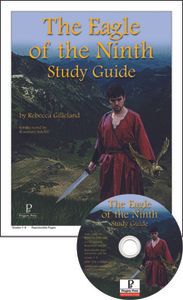
We received a downloadable copy of the Eagle of the Ninth Study Guide and answer key to review, which is one of the guides Progeny Press offers for middle school (grades 5-8). It's interactive, which means that the PDF file allows the student to type their answers into the answer fields and save them. I printed out copies for the girls, because I'm mean like that. (Actually, we only have one computer in the school room, and they aren't very good about sharing it.) I've wanted the girls to read this book, and perhaps the entire trilogy, since it goes along nicely what what we're studying in history this year. I hadn't gotten around to assigning it, though, so this presented a great opportunity to do that and see how we would like using a literature guide.


The Eagle of the Ninth is a book about a young man named Marcus, who becomes a commander in the Roman Legion in Britain, hoping to discover what happened to his father. The literature guide begins with a list of suggested pre-reading activities, which are excellent. Since we've read quite a bit about Roman Britain, though, we jumped right in to reading the book. I tried having the girls read on their own, but they really preferred that we use it as a read-aloud, so that's what we did. The guide is set up to cover three chapters of the book at a time, so we read the first three chapters together, and then looked at the questions.

Each section of the literature guide is organized like this:
  • Vocabulary - Different activities help the studentes think about the words in different ways, including multiple choice, finding synonyms and antonyms, matching a word to its definition, etc.
  • Questions - Narration questions
  • Thinking About the Story -  Draws attention to literary elements, and important details of the story
  • Dig Deeper - Students are asked to consider how the main character is feeling or thinking and why, and consider the situation through the lens of Scripture 
Sometimes, at the end of a section, there would be a Classroom Discussion question, or Optional Activities, such as a writing project. a research project, or a demonstration the student could do. Some of these activities were better suited for a classroom setting, but most worked in a homeschool setting as well. At the end of the guide is an Overview section, a list of possible Essays and Projects, and finally, a list of Additional Resources, including other books by the same author, other books related to the same topic, and relevant movies with their ratings so you could choose what is appropriate for your family.

This was a challenging activity for my girls. We haven't done much with formally identifying literary elements, such as hyperbole, foreshadowing, allusion, etc. It was good for us to define them together and identify them in the story. I also liked that the "Digging Deeper" questions gave Scripture references and asked us to think about how we, as Christians, might respond differently to situations encountered in the story. I found that it was better for us, at least this first time using a literature guide, to discuss things together rather than have them attempt to answer the questions on their own.

This is an excellent literature guide. If I were teaching in a classroom or co-op setting, I would much prefer to use something like this over assigning a standard book report. I thought the discussions generated by the questions in the guide were wonderful, and I enjoyed looking at the literary elements with my girls. I don't feel that the guide analyzed the book to death, or told the girls what they were supposed to think about what they were reading, which is a concern of mine. 

I would probably use this as a tool for me, the teacher, in my homeschool, rather than assigning it to my students.  I could see using the questions to bring out more discussion if I felt they were missing key points after hearing them narrate, and perhaps pick and choose from the optional activities if I thought there was one that would be particularly helpful to them. Charlotte Mason taught that students need to make their own connections when reading a book, and as the teacher, I should not come between the student and the author. They've practiced narration for so many years, they're quite good at it. I don't feel this is something we need at this point, but I might want a tool like this as we get into high school studies.

The Eagle of the Ninth Study Guide is available from Progeny Press for $16.99 for the digital download or CD, and $18.99 for the printed booklet. 

Click here to read more reviews from the Schoolhouse Crew!



Sunday, April 14, 2013

REVIEW - Supercharged Science


Have you ever heard of Supercharged Science? I have heard a great deal about this company over the last few years, and have been itching to try their e-Science program. Aurora Lipper, author of the program, has a Master's degree in mechanical engineering, taught as an instructor at Cal Poly State University and worked at NASA on rockets and jets. She is a ROCKET SCIENTIST - for real! She was struck by how bored students were with science, and couldn't understand it - until she learned how most of us are taught about science in school. She set about creating her own lesson plans for science, and after teaching her first lesson to a group of local elementary students with great success, she went on to have a science camp. All this gradually evolved into Supercharged Science - a program that is fun for children and easy for adults to implement.


Aurora's approach is to teach science "from the inside out" - let children do some experiments, see how cool the results are, and then teach what's behind it all once they are hooked and excited to learn more. You don't just throw supplies at them and let them have at it, either. She encourages students to keep a science notebook, and carefully record what they do along with their results. She teaches them how to work with the scientific method and do things correctly. Here is a list of topics covered in the program:

Scientific Method Energy Light Thermodynamics Earth Science
Mechanics Sound Electricity Electronics Science Fair Projects
Motion Astrophysics Magnetism Life Science Mathemagic
Matter Chemistry Alternative Energy Biology


Would you like to see some of the things we did? I knew you would! Let's take a look, shall we?

We started out with the Scientific Method unit, because we've done very little formal science and I don't believe we've ever discussed it. The first thing they did was see how many drops of water would stay on top of a penny before it all splooshed out. Using an eye dropper, they counted the drops as they went along. It was interesting to note that Emma got quite a few more drops to stay on her penny than Abbie did.


After that, we decided to start with Unit 1, Mechanics: Force, Gravity and Friction. We had most of the supplies around the house, so it was a good place to begin. First, we read together the unit overview, vocabulary words, and text, and then I had them do some experiments. First, we looked at magnetism.

I decided that we would look at eletromagnetism using a balloon and a cat. Aurora didn't tell us to do this experiment, I promise, but it was a great deal of fun and we laughed a LOT. (No cats were injured while a balloon was stuck to them.)


Then, we went outside with a compass. I have never used a compass, and wouldn't know how to get myself anywhere with one, but they work because the magnet inside can detect the earth's magnetic field, and it makes the needle in the compass always point to the north. (The experiment was to show us that the earth *has* a magnetic field, not to understand exactly how a compass works.)


We also looked at magnetism in o-shaped cereal. It turns out that if you put some of the cereal in a bowl and stir them around so they have to move away from each other, they attract back together into a group.

Next, we took a look at gravity. This was highly entertaining for me. First, I had the girls jump into the air to see if they would come back down. Guess what? They DID! I had them repeat this a few times to make sure our hypothesis was sound. Then, we tried it with a rubber ball, and learned that, indeed, gravity still worked.

Gravity works! :-)
We moved on to find out whether an object thrown horizontally will fall at the same rate as one that is dropped (it does, much to my surprise), and then did another experiment to see if weight figured into the equation (it doesn't seem to - opposite of what I thought). These were all simple, but we had FUN while we were doing them, and they had to think about what was happening and why. After we did the experiments, we completed the corresponding exercises in their science journals.

The way the program works is this: you sign up for a monthly subscription, which costs $37 per month for grades K-8, or $57 per month for grades 9-12. For the first month, you are given access to the first seven units: Mechanics, Motion, Matter, Energy 1, Energy 2, Sound, and Astrophysics. Each month after that, you will receive access to two more units, in the order given on the website. If you see something else you want to try sooner, you can email them directly and they will give you access. Also, they have conversion charts available that show you how you can use the program in conjunction with several popular homeschool science programs. As you consider signing up for the e-Science program, be sure to read their terms of service (as you would for any other subscription program). They do have a 30-day satisfaction guarantee. If you'd like to try it out before you subscribe, you can sign up for some great free stuff and try it out.

There is a TON of information on this website. It feels a little overwhelming at first, actually. However, once I took a deep breath and started really looking at what was available, I was impressed. I like that there is so much hands-on learning to engage a child. Even the "textbook reading" is very well done - it's written in a conversational tone to the student. Aurora Lipper is passionate about science, and it shows in all aspects of the program. She is also available to answer any questions you may have.

The girls and I *loved* using this program. It really is accessible for all ages. There was a lot that Isaac could do and understand along with us. They appreciated the hands-on learning and looked forward to doing science. This program is a great example of living science and worth considering for your homeschool.

 Click here to read more reviews from the Schoolhouse Review Crew!