Pages

Monday, April 21, 2014

Spring Nature Study: Wildflowers

This post contains affiliate links.
That's Pinteresting

I love spring. I think it's everyone's favorite time of year, don't you? My very favorite part of spring is wildflowers. I love this time of year in North Carolina! There are flowers popping up all over the place.

My favorite book for identifying wildflower is the National Audubon Society Field Guide to Wildflowers, Eastern Region. They also make one for the Western Region. The nice thing about these books is they're organized by color and shape, so you can look up things like "yellow daisy and dandelion-like" flowers. These books are by no means definitive, but they're the easiest to use for me. I just got Newcomb's Wildflower Guide, which is supposed to be pretty cool, but I haven't quite figured it out yet. It's for a fairly specific region of the U.S, basically north Georgia up through New England, but it is supposed to be a better way of identifying wildflowers.

Some local friends have started a nature club, and our first subject is wildflowers. We were able to attend for the first time last week. We met them at South Mountain State Park, and looked along the walking trail to see what we could find. Take a look!

Here are some fiddleheads (ferns just coming out of the ground):


Then we found these Mayapples, or Mandrakes:


They weren't flowering yet, but we did see buds. Maybe they'll be in bloom next time! These used to grow in the woods where I grew up. (We did not dig any up to see if the roots were screaming babies. No picking the flowers!)

And then we saw this lovely trillium:


When I looked up the trillium in my wildflower guide, I learned that it is also called "Stinking Benjamin." Apparently, the flowers smell like carrion, which attract carrion-feeding flies for pollination. I'm glad I didn't get close enough to the flower to try to smell it.

When we saw this flower, we had a hard time figuring out what it was. I kept thinking, "Wow, that looks like chickweed, but the flowers are so big!" Come to find out, it's GIANT chickweed! It's also called star chickweed. I know not everyone loves having chickweed around, but I think it's pretty.


We also saw three kinds of violets! I love violets. They remind me of my grandmothers. They grew everywhere in Michigan. Here, they grow wild, and pop up all over the place. We find them in our yard, volunteering their beauty. I had never seen a yellow violet before, I don't think, and I am not sure I'd seen a Canada violet, either. 


The last thing we were able to identify was foamflower. They're so pretty. I used to have some in my flowerbeds when we lived in Apex, but I'm sure they were a hybrid variety. It was such a lovely surprise to find them growing in the wild.


We were hoping to be able to spend some time dry-brush painting in our nature journals, but it was chilly and windy, so we decided to do that next time. 

My friend Jenn over at Simblissity has created some lovely nature journal pages for you, if you'd like to print them off and get started on your very own study of the spring wildflowers in your area. I'd love to know what you find. What is your favorite?

Be sure to check out  the Spring Studies Crew Carnival and see what other folks are doing!

Friday, April 18, 2014

Hymn Study Helps: Go to Dark Gethsemane

In our little Charlotte Mason co-op, we are currently studying the hymn, "Go to Dark Gethsemane" by James Montgomery. It is a beautiful hymn, and I don't remember singing it before Sara introduced us to it. I've found myself connecting with hymns as never before, and this one has touched my heart particularly this last week, as we've walked with Christ during the Holy Week readings at our church.

As I've been singing this with my children, I see Christ so vividly, praying not to have to be crucified, and yet going willingly because He knew it had to be. I am so grateful for His sacrifice for me, and this hymn reminds me so beautifully to turn to Him when things seem too hard. The petty struggles of my day-to-day life come sharply into focus in proper perspective when I consider what He has done. I hope this hymn will bless your Good Friday meditations.


Go to Dark Gethsemane
James Montgomery

Go to dark Gethsemane, ye that feel the tempter’s power;
Your Redeemer’s conflict see, watch with Him one bitter hour,
Turn not from His griefs away; 
Learn of Jesus Christ to pray.

See Him at the judgment hall, beaten, bound, reviled, arraigned;
O the wormwood and the gall! O the pangs His soul sustained!
Shun not suffering, shame, or loss; 
Learn of Christ to bear the cross.

Calvary’s mournful mountain climb; there, adoring at His feet,
Mark that miracle of time, God’s own sacrifice complete.
“It is finished!” hear Him cry; 
Learn of Jesus Christ to die.

Early hasten to the tomb where they laid His breathless clay;
All is solitude and gloom. Who has taken Him away?
Christ is risen! He meets our eyes; 
Savior, teach us so to rise.


Click here for a PDF of music with lyrics. 

James Montgomery was born in Scotland in 1771. When he was 2 years old, he moved with his parents to a Moravian community, where they left him to go to Barbados as missionaries. James was orphaned when his parents died on the mission field. He attended an English Moravian seminary for a while, but was dismissed because he was preoccupied with writing poetry. Eventually, he became editor of a newspaper called the Sheffield Register, and when the owner of that paper had to leave the country to avoid persecution and imprisonment over his political writings, James bought the paper and renamed it the Sheffield Iris. He also wrote political editorials, and was put in prison twice because of his writings. Before his death in 1854, he wrote over 400 hymns, 100 of which are still used today. The one I'm most familiar with is "Angels from the Realms of Glory." (Sources: Then Sings My Soul, Morgan; 101 More Hymn Stories, Osbeck)

Sunday, April 13, 2014

Blogging Essentials Giveaway!


Blogger Essentials #giveaway ARV $440 @picmonkey @inlinkz @passionfruitads @RebeccFlansburg Starts 4/13
 

Welcome to the 
Blogging Essentials Giveaway 
hosted by 
The Squishable Baby.


This giveaway is part of the Boost your Blog - Giveaway challenge (#BB100).  The purpose of this giveaway is to boost another bloggers blog - whether they are a new or a seasoned blogger.  I am hoping that the winner will be provided with the necessary tools to either start their blogging journey on the right foot, or improve upon the blog that is already started.  I have gathered a variety of exciting tools.  One winner will receive:
   
  • 1 year subscription to PicMonkey - Create professional images and graphics
  •    
  • 1 year subscription to Inlinkz - Host  blog hops and linky parties and also organize affiliate links
  •    
  • 1 Year subscription to Passionfruit Ad Swaps - Network with other bloggers easily
  •  
  • Choose between a free blog design, redesign, SEO work-up or Graphic overhaul from Amber Galore and create the blog that is going to take you to the next level
  •    
  • 1 hour consultation with Amazing Success Academy and learn the tools you need for success

  • Read the review of these two great ebooks here.


    #bloggers enter the Blogging Essentials #Giveaway & #win subscriptions to @picmonkeyapp @inlinkz free blog designs via @ambergalore and more  RV $440

    Enter below for your chance to win this grand prize!

    Open Worldwide!


    The Squishable Baby, Boost Your Blog Participants, and participating bloggers are not responsible for prize distribution.

    Friday, April 11, 2014

    REVIEW: Hey Mom, I'll Start Dinner Cookbook and GIVEAWAYS!


    Be sure to read all the way to the bottom and enter the giveaways!

    I have not been good about teaching my children to cook. That's just a fact. I want to have them help me in the kitchen, but I don’t have a plan that allows me to do that most days. I was THRILLED, therefore, when a friend posted that her cousin, Cherilyn Dahlsten, had written a cookbook for kids entitiled, “Hey Mom, I’ll Start Dinner,” and even more excited to review it! 

    Cherilyn is a working mom of four boys. She created this cookbook using recipes she tested on her own family, and each one is something they like to eat on a regular basis. Her passion is not cooking, but raising confident, unselfish kids who contribute to the family. This cookbook is one tool in our parenting toolbox to achieve that.

    The cookbook is a large format paperback, 8.5"x11", but not terribly thick. The recipes are color-coded by difficulty with color pictures, and include a bit of everything: main dishes, soups, side dishes, and desserts. There are also full-color pictures of the kitchen tools used in the book so children can figure out what they need independently. The instructions are written to the child, assuming they know nothing. There are also "night before" instructions where applicable, generally written to parents so you can be sure your child has what they need to make dinner independently. It will encourage you to plan your meals ahead, too, so that you have the ingredients on hand for the recipes you want them to make.

    The first recipe we tried was Chicken Pot Pie. Abbie (age 13) made it one night when I wasn’t home, so no one took pictures. She was a little offended by how easy it was to make, which made me laugh! It was quite tasty, though, so I know it’s something we will have again and I can have either of the girls put it together and pop it into the oven. We had it again during the review period, and my older daughter made it with the same tasty results.

    I had Emma make Meatballs and Garlic Mashed potatoes, and they were excellent. We chose to use oatmeal instead of bread crumbs in the meatballs, Abbie gave up bread for Lent, and it did seem to give them a slightly different texture, but they were still good. There were NO potatoes left after dinner and we willingly ate the meatballs as leftovers.

    Abbie just could not decide what she wanted to make next, so I assigned "Uglies," just because I thought the name was fun.  They turned out really well too, and were gone by the next day. I kept hearing, “Who ate the rest of the Uglies?” Abbie requested that I get more barbecue sauce (between the meatballs and the Uglies we used all I’d bought) and biscuit dough so she could make them again, and they were just as tasty the second time - maybe even better because I got better barbecue sauce.

    Peanut Butter Cookies!
    Abbie also made peanut butter cookies. The girls have been making cookies weekly since last summer for their dad to take to work, so are good judges of recipes, and found Cherilyn's to be easy to follow. The received the "Cookie Wednesday Seal of Approval" from the folks at my husband's office, too.

    Although Isaac isn't reading on his own yet and is just 6, I am planning to go through this with him as well. He is certainly capable of chopping things and getting started learning alongside me when I cook, which will make it that much easier when he's old enough to take a turn making dinner too.

    I really, really love this book. Love it. It gave me simple plan (key word: simple) to get my kids in the kitchen, both with and without me, so they know how to feed themselves when they eventually leave home. It's been wonderful to hand dinner prep off to someone else now and then. My girls might not show a great deal of enthusiasm when I ask them to cook, but I can see the pride they take in their accomplishments when we eat what they've made. We're going to use this book often, and I can see it being especially useful this summer, when I will be gone more than usual to conferences and on a trip with Abbie. My peeps at home will have a greater variety than macaroni and cheese and spaghetti in their diet.

    The cookbook  is available through the Hey Mom, I'll Start Dinner website, and Amazon.com (aff. link). You can also see sample pages at HeyMomIllStartDinner.com.

    Be sure to connect with Cherilyn on Pinterest, Facebook and Twitter. And don't forget to check out her blog, where she shares recipes and tips!


    I received a copy of this book in exchange for my honest review.


    Enter to win an ebook copy of Hey Mom, I'll Start Dinner!

    a Rafflecopter giveaway


    Enter to win one of three fabulous prizes!
    a Rafflecopter giveaway

    Day 5: Be Intentional

    Here we are on day 5 of the 5 Things Blog Hop! Thanks for hanging out with me! Today I'd like to talk to you about making sure nature study becomes a regular part of your life.

    If you're new to nature study, it's important to build nature study into your routine and make a point of sticking with it until it becomes a habit. You know what I'm talking about. I start out every week with the best of intentions, but somehow, things happen and important things like nature study go by the wayside. While you're getting into a groove, make sure nature study happens, even if it means math (gasp!) slips a little.

    Here are some things to try:

    Spend some time outside every day. In a session on high school science at the Charlotte Mason Institute Conference a couple of years ago, the speaker told us she went outside every morning with her coffee and just observed. When she was done, she came back inside and recorded what she'd seen and heard in her nature journal. What a great way to record the seasons!

    Depending on where you live, you might have to get creative at certain times of the year. In North Carolina, it's extremely hot and humid in the summer. My fair-skinned redheaded beauties just cannot be outside during the hottest parts of the day. We have to go out in the early morning if we're going to go out at all. We can be outside nearly all winter, though, and some of you who live in colder places will have to think about how to get outside when it's really cold, even if just for a few minutes each day.

    Schedule a topic for weekly, purposeful nature study. Nature study is different than a nature walk, Ambleside Online has a schedule laid out on their Nature Study page, and they have links to great information there. The Handbook of Nature Study website has the Outdoor Hour Challenges, and are a nice way to structure your studies.
    or being outside to see what you might find. You want to choose a topic and focus on that for a term. The easiest beginning study is probably birds. Birds live wherever you are. You can put up a small feeder and see who comes to visit. You could spend an entire year on birds alone!

    Find a new place. Is there a park close by? A pond or stream? Can you get to a nature preserve or botanical gardens? Perhaps there is a science museum with a butterfly house you can visit. It's worth making a special trip. Consider choosing one place and really get to know it throughout the year. What blooms, and when? What animals do you see? Are their migratory birds that only appear in the spring or fall?

    Adopt a tree or two or three for the year. What's in your yard, or nearby? Trees make a great nature study subject, because they change with every season, and they don't move. Learn what kinds of trees you have, what their bark looks like, when their leaves come out, what kind of flowers they have, what their seeds are...

    Mark off a specific spot in your yard, 1'x1', and observe what happens there throughout the seasons.  What do you find there? Bugs? Grass? Flowers? Check out this Squidoo lens for ideas.

    I hope you've enjoyed our brief foray into the wonderful world of nature study. I will be sharing more on this topic soon. I hope you'll join me and share what you're doing!


    Don't forget to check out some the other participants in the 5 Days Blog Hop:


    Aurie @ Our Good Life ~ Photography Tips and Tricks
    Dinah @ The Traveling Classroom ~ Tips for Learning a Second Language
    Julie @ Nurturing Learning ~ Art Resources
    Tara @ This Sweet Life ~ Preparing for a New School Year
    Sara @ Embracing Destiny ~ Purposeful Living
    Rebekah @ There Will Be A $5 Charge for Whining ~ Culinary Adventures for Boys
    Beth @ Ozark Ramblings ~ Photoshop Elements for Homeschool
    Hillary @ Our Homeschool Studio ~ Fitting in the Extras

    And, you can click on the banner to see everyone who's participating!

    April Blog Hop

    Thursday, April 10, 2014

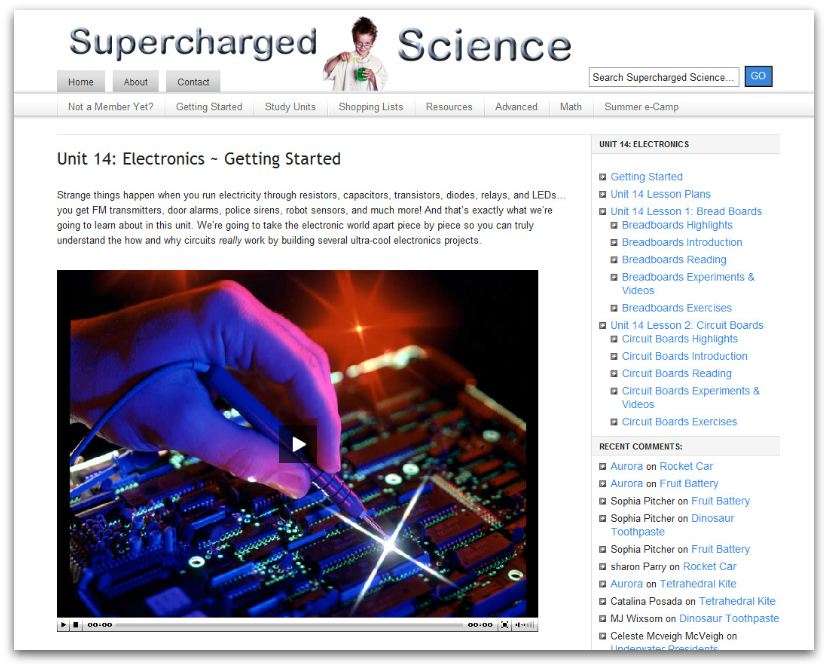
    REVIEW: Supercharged Science


    I'm always looking for good science options, so was excited to review the e-Science Learning Program from Supercharged Science. We received a 6-month subscription to the K-12 program.

    Aurora Lipper is a real-life rocket scientist with a passion for getting kids interested in science. She started out teaching a group of elementary students about supersonic combustion, then held a science camp, and eventually put together her SuperCharged Science program. She has lots of teaching resources on her site, as well as a homeschool blog, and offers an e-science camp in the summer. She is even available for weekly Q&A sessions on the phone!

    There is a TON of information in this program - over 600 experiments! If you look at it all and feel overwhelmed, Aurora has a nice Science Activity and Video Series put together as a place to start. Each one contains five simple experiments with videos explaining what to do.

    You can choose to use the e-science program in several different ways: by grade level, by topic, and by interest. You can use it as your primary science program, or as a supplement. They provide "conversion charts" that help you correlate your homeschool science curriculum with the e-Science program. If they don't have a chart for your program listed, they will make one for you if you send them the TOC from your book. (I was excited to see that they offer correlation to Secrets of the Universe by Paul Fleischer, which we used with Ambleside Online last year.)


    The topics included in the e-Science Online Learning Program are as follows:
    • The Scientific Method
    • Mechanics
    • Motion
    • Matter
    • Energy (2 units)
    • Sound
    • Astrophysics
    • Chemistry (2 units)
    • Light
    • Electricity
    • Magnetism
    • Alternative Energy
    • Thermodynamics
    • Electronics
    • Life Science (2 units)
    • Biology (2 units)
    • Earth Science
    • Award-Winning Science Fair Projects
    • Mathemagic
    They're working on adding even more hands-on worksheets for advanced students, which will be equivalent to college and real-life science work.

    We decided to do delight-directed science this time, and selected some I knew everyone would enjoy, even my 6-year-old. All three of my children really enjoyed the experiments we chose. My girls, at 13 and 14, are old enough to try most of them on their own. One fun and simple activity was the Microwaving Soap experiment in the "Solids" section of the unit on Matter. I had never done it before, and it was fascinating to see what happened. I only bought three bars of soap, which was probably a good thing because otherwise I'm pretty sure we'd still be trying different variations! As you can see from the pictures, I had a captive audience.

    There is a lot to love about this program. You're intended to do experiments first, then learn the "why" behind them, which is the best way to learn science. Students are encouraged to keep a science journal with their hypothesis and results, which has been a lot of fun for us. There are is something for every age, and you can have all your children working on the same topic with age-appropriate material. I love having the experiments available to use alongside whatever science we have, and it would also be an excellent stand-alone science program. Most of the supplies needed are common household items, and if they're not, links are provided for ordering online. The only real drawback is the cost. The monthly cost is a significant chunk of our homeschool budget, and while science is obviously important, it's not the only important thing.

    The e-science Premium Membership is available for $57 per month for grades K-12, or $37 per month for K-8. When you sign up, you're given access to 1-2 levels per month, but if there's a topic you'd like to cover and you don't have it yet, you can just email them and they will get it set up for you. Note: because this is an online program, there are some technical requirements you'll want to check.

    If you'd like to see what using Supercharged Science is like, click to sign up to receive a free copy of Aurora's Science Activity Video Series and Guidebook. Also, Aurora is offering a fantastic special: try e-Science for one month for only $1! Click here to find out how to take advantage!

    Connect with Supercharged Science on Facebook, Twitter, YouTube, Pinterest, and Google+. Don't forget to check out their blog!

    Click to read more reviews from the Schoolhouse Crew!


    Day Four: Keep a Nature Journal

    One of the most enjoyable things for me, since beginning nature study with my children, has been keeping a nature journal. I am not nearly as consistent with it as I'd like to be, but it brings me a great deal of pleasure when I'm able to sit down with my colored pencils or watercolors and add a picture. I also like to try to write things in it, such as today, when I heard a Carolina wren singing on my front porch (loudly) and saw another one on my window sill with a piece of what looked like mulch from my flower bed, obviously headed for its nest.

    My first dry brush
    attempt
    I was first introduced to nature journaling at the Charlotte Mason Institute Conference a few years ago. A lovely woman named Deborah Dobbins and her daughter, Holly, took our class on a nature walk, and instructed us each to pick a specimen to record in our journals. I chose a ginkgo leaf and seeds. When we got back to our classroom, she had us sit and look closely at our specimens for one minute, noting every detail we could see. Then we got to paint them in our books, using the dry brush technique with watercolor paints. (In a nutshell, you use a very small paintbrush like a pencil, using as little water and as much pigment as possible.) It was a lot of fun, and after taking the time to carefully observe my leaf, I noticed many more details about it than if I'd just picked it up and started painting.


    In our little Charlotte Mason co-op, we have been learning more about the dry brush technique and mixing colors. We've learned that in order to mix colors that are as true to nature as possible, we need to use CMYK colors, rather than the "primary" colors we normally think of. My friend Sara, who is in charge of nature study during our co-op time, found that she could not mix the color of a henbit flower from the paints she had, and that's how she learned she needed magenta, rather than red. (Here is some nice information about CMYK colors.) I invested in Winsor Newton Cotman watercolor sets for myself and my girls (Cotman are the less expensive version, also available at craft stores), and found that they didn't come with magenta (Permanent Rose is the WN color name) so I've ordered some for us. We have also used Prang watercolors and liked those too. You can order a magenta from Prang, as well, but we haven't been able to determine if they have anything comparable to cyan.
    Emma's Maple Tree
    We use Canson Field Sketchbooks (aff. link) for our nature journals. They have a nice hard cover, and the paper holds up well to painting. Plus, they're readily available at local craft stores and I can almost always find a coupon! If you can't purchase one right away, you can make your own. Here is a fun tutorial from the National Wildlife Federation.


    Emma's Mockingbird
    We've used both colored pencils and watercolors. I find pencils to be more convenient when we're outside on a walk, but I like to have us work on our dry brush painting, too, when we bring specimens back to the house. I'll be honest: we find dry brush much more challenging than drawing and coloring with pencils, but it's an important thing to practice. You really have to pay attention to what you're doing with dry brush. And, as we discussed at our last CM book club meeting, it's not about perfection, but about encouraging the connection between a child and what he sees. Skills will improve, and each moment preserved in a nature journal is precious.

    Nature journals can be whatever you want them to be. You can draw or paint
    things you find outside. You can copy poetry if it comes to mind. You can write little snippets of what you see every day - you don't even have to use complete sentences if you don't want to! C'mon, everyone has a little bit of rebel in them somewhere, right? You can draw scenes, such as your yard when spring starts to visit. Spend 15 minutes outside first thing every morning, then come in and write your observations. The possibilities are endless.

    Probably the hardest thing (at least for me) is letting a child be in control of their own nature journal. I'm no great artist and I don't pretend to be able to instruct them in the finer points of technique, but often their connection is not mine. They do have to make some assigned entries during our nature study time, but when they just go outside or we're on a nature walk, they are free to choose. I'm sure my son will have no end of insects and worms in his, and I would really rather see him try to draw flowers, you know? 

    Keeping a nature journal is not only a source of pleasure, but an important piece of a child's education. It will encourage them to be a life-long observer of the world, to become intimate with nature. Just get started - don't let anything hold you back. 


    Here are some helpful resources:


    Don't forget to check out some the other participants in the 5 Days Blog Hop:


    Aurie @ Our Good Life ~ Photography Tips and Tricks
    Dinah @ The Traveling Classroom ~ Tips for Learning a Second Language
    Julie @ Nurturing Learning ~ Art Resources
    Tara @ This Sweet Life ~ Preparing for a New School Year
    Sara @ Embracing Destiny ~ Purposeful Living
    Rebekah @ There Will Be A $5 Charge for Whining ~ Culinary Adventures for Boys
    Beth @ Ozark Ramblings ~ Photoshop Elements for Homeschool
    Hillary @ Our Homeschool Studio ~ Fitting in the Extras

    And, you can click on the banner to see everyone who's participating!

    April Blog Hop

    Wednesday, April 09, 2014

    REVIEW: Star Chronicles: A Bible Based Study of the Stars


    Make sure you scroll all the way down for the giveaway!

    I was recently given the opportunity to review a new book by Dawnita Fogleman entitled Star Chronicles: A Bible Based Study of the Stars. I love astronomy, and have wanted to get started with some family studies, but wasn't quite sure how to go about it. We have a pretty cool iPad app that helps us identify what we're seeing, and I have quite a pile of books about stars and planets and such, but wasn't sure how to approach it all. I was given a PDF copy of the book to use with my family. It includes coloring pages for the youngest astronomers, as well as lapbooking elements and notebooking pages.

    Dawnita is a wife, mother, editor and author of most of her website: Fogleman Forerunner. She is also a 5th generation Oklahoma Panhandle pioneer - how cool is that? She lives in a century-old farmhouse on 50 acres in, as she describes it, "Nowhere, Oklahoma." Sounds like heaven to me! She also loves old books. (That has nothing to do with the review, but it tells me she's a woman after my own heart, so I had to point it out.) You can read an interview with her here. She's nifty.

    The first thing I did upon receiving Star Chronicles was to pull out all the books I could find relating to astronomy, fiction and non-fiction, and put them on top of the piano, where they would be visible and available to everyone. Then, I put Dawnita's book on our iPads. My girls and I each read through the book, and then the girls started researching constellations. They are 13 and 14, so they're able to do research on their own, and they went to town. Dawnita recommends studying one constellation per week or even per month, giving time for all the information to soak in. She said it's not necessary to work on the constellations that are currently visible, although that would make the most sense to me.

    That's not what the girls did, naturally. For their first ones, Emma chose Aries, because that's her "sign," and Abbie chose Virgo, probably because it was the first one, and she's singing a song in Latin that uses the word "virgo" in her choir. All right then! (I suppose Aries is the right one, come to think of it.)

    Our printer isn't working, so I couldn't print any of the notebooking pages, but we like to do our own thing anyway. Emma chose to do hers with Picmonkey:


    Abbie made her own version Dawnita's drawing of Virgo, colored it, and attached it to her narration page:


    This book is a great jumping-off point for a study of constellations. There is just enough information here to satisfy younger children, and plenty to pique the interest of older students to make them to learn more. I had only ever heard about the constellations with their Greek names, but there is so much more history there! You can see a sample lesson (Scorpio) here. Dawnita's focus was to share Biblically and historically accurate information, and you will not find anything about horoscopes or astrology. She shares information about the 12 major constellations, along with any associated constellations. I had no idea there were so many!

    We learned a lot from this study, and enjoyed it. Dawnita's goal was to make the book friendly and engaging, and she succeeded in that. The full-color star maps are amazing. She shared many of her own connections with the material, and those were fun to read. I can think of a few things I'd like to see:
    • Consistent information regarding when each constellation appears in the sky.
    • Sources to verify information found on Wikipedia.
    • A little more direction with regard to the Bible prophecies. For example, when we read about Aries, the Lamb, she had us read Luke Chapter 1 and discuss the prophecy. I could not for the life of me figure out what that chapter had to do with Aries; there is no mention of the word lamb anywhere in the chapter. I know this isn't a prophecy study, but if we're directed to read one, it would be helpful to know why. (Note: I had another friend explain to me that it was talking about Christ coming to redeem us, our Sacrificial Lamb (even though it didn't actually refer to him as the Lamb). I felt a little silly, once I heard the explanation, but I am new to studying Biblical prophecy, and just didn't make the connection.)
    I confess that I found myself a little frustrated after reading the book, and couldn't quite put my finger on why, until I realized that I wanted to know MORE! I'm in the process of reading Adam and His Kin by Ruth Beechik, one of Dawnita's recommended books for older students to read along with this study, and will be seeking more information for myself. I'd say that's a unit study well done, when it inspires a learner to keep learning!

    To celebrate the release of her new book, Dawnita is offering a 25% discount on the PDF version, available through her website, using the code STARMOMS. This code expires on April 20, 2014.


    The PDF version is regularly $12, and is available through Dawnita's shop. A printed version is available through Amazon (affiliate link).

    One more thing! I'm authorized to give away a PDF copy of the book. Be sure you enter to win!


    Read what others had to say about Star Chronicles!

    Connect with Dawnita via Fogleman Foreunner on Facebook, Twitter, and Google+. Don't forget to check out her blog!


    Hey Mom, I'll Start Dinner Reviews


    Hey Mom, I'll Start Dinner! is the first cookbook written by Cherilyn Dahlsten, a working mom of four boys. She's passionate about raising great kids, and has found that making kids a part of meal time preparation goes a long way toward raising confident, contributing, unselfish kids. Each recipe in this book has been written with explicit instructions so that a child (around age 12; younger with some adult assistance) can make them independently.  Our team of reviewers has spent 6 weeks or so using this book with their children, and we're excited to share our reviews with you.


    KEEP GOING TO ENTER THE GIVEAWAY!


    a Rafflecopter giveaway

    Your job: Educate Yourself


    This post contains affiliate links.

    Now that you're outside, it's time to start learning about things. You and your children will love identifying all the things you find!

    Please don't feel intimidated if you feel like you don't know anything about nature, or enough to teach your children. Everyone has to start somewhere. I thought I knew a fair bit, but honestly, it's so different in North Carolina than it was in Michigan that in many ways I started all over when we started nature study here. That's okay with me, because I love nature study and I love sharing it with my children.

    The most important thing is to learn as you go, and intentionally work on increasing your knowledge. You aren't expected to give lectures when you go outside, I promise! You simply want to be able to answer questions from your children, and perhaps direct them if you're working on studying something specific. For example, if you happened to want to start with birds, you might see a robin hopping along looking for worms. If your children are focused on something else, you might say, "Look over there! What kind of bird do you think that is?" and go from there.

    Consider this quote from Charlotte Mason:


    There are MANY great natural history books out there that will teach you about wildlife from a non-scientific perspective, and I highly recommend reading books like that. I will make some suggestions in a future post. For today, though, I'd like to share some basic resources to get your nature studies off to a good start.

    The first resource I'd like to recommend to you is the Handbook of Nature Study by Anna Botsford Comstock. This is a huge book. It's really thick and heavy, and it's not one that you are going to carry around with you. However, it is full of amazing information, and is a wonderful guide for you, the teacher. There is also the Handbook of Nature Study blog, home of the Outdoor Hour Challenge. Barb McCoy, the author, has graduated four children from her homeschool, and started the blog as a way to share their nature study adventures. Her blog is a great place to learn how to use your ginormous Handbook of Nature Study, and the Outdoor Hour challenges are wonderful! Here is her Getting Started page.

    I also hope you'll consider investing in some field guides. These can get expensive, but they are a worthwhile investment. There are online resources for identifying things, but field guides are invaluable. You can take them with you much more easily than you can tote a computer, and believe me, the last thing you want to do when you're outside with your kids is whip out your phone (unless it's to snap a quick picture). Keep an eye out at thrift stores, because you can sometimes find them there. In our local nature club, my friend Cheri recommended two books for beginning nature study. We live in North Carolina, so the first book she recommended is the National Audubon Society Regional Guide to the Southeastern States. This book covers the states of Alabama, Arkansas, Georgia, Kentucky, Louisiana, Mississippi, and North Carolina. You will find information on many topics in this book, including birds, trees, wildflowers, insects, reptiles, and more. It's a little bit about a lot of things, and is the perfect book to get your nature studies off the ground. These would also be great books to take along when traveling.

    The National Audubon Society has eight regional guides available:


    The other book she recommended to us is the Peterson First Guide to Caterpillars of North America. You will most likely find caterpillars when you're outside, and it's helpful to be able to figure out what they are.

    That's it! That's really all you need to get you started. We do have some other fun things we like to have around, and I thought I'd share them with you.

    • Small magnifying lenses are great for looking at things that don't move much, like lichens and tree bark and leaves. 
    • You might enjoy having a magnifying jar. You can capture insects or other small things in them, and the magnifying lid helps you see them in more detail. I will warn you that house centipedes look like something out of a horror movie when magnified.
    • One last thing we have is a "critter keeper." If you find something you'd like to take home and observe for a few hours, or even a day or two, it's nice to have one of these handy. We've kept a toad in ours, and various insects. When we found our praying mantis, she got to hang out in there until we got her permanent residence set up.
    I hope you're enjoying our brief foray into the wonderful world of nature study! I'm trying not to overwhelm you with too much information. I will have more resources to share at a later date. 


    Don't forget to check out some the other participants in the 5 Days Blog Hop:

    Aurie @ Our Good Life ~ Photography Tips and Tricks
    Dinah @ The Traveling Classroom ~ Tips for Learning a Second Language
    Julie @ Nurturing Learning ~ Art Resources
    Tara @ This Sweet Life ~ Preparing for a New School Year
    Sara @ Embracing Destiny ~ Purposeful Living
    Rebekah @ There Will Be A $5 Charge for Whining ~ Culinary Adventures for Boys
    Beth @ Ozark Ramblings ~ Photoshop Elements for Homeschool
    Hillary @ Our Homeschool Studio ~ Fitting in the Extras

    And, you can click on the banner to see everyone who's participating!

    April Blog Hop